
Bicolor Cat Names: 80+ Ideas for Color-and-White Coats
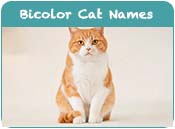
A bicolor cat wears just two shades, a single base color broken up by patches of pure white. That white comes from the white-spotting gene at the KIT, or S, locus, an incompletely dominant gene whose dose decides how much white shows. A light sprinkle gives only a locket or white toes, while a heavier dose pushes the white up over the chest, legs, and face. Cat fanciers, following Pat Turner, grade that range from solid through mitted, standard bicolor, harlequin, and finally the van, where color survives only on the head and tail. Any base color can pair with white, so bicolors come in black-and-white, blue-and-white, red-and-white, and tabby-and-white, all distinct from the three-color calico or tortie. For naming, the patchwork itself is rich inspiration. Pattern-driven picks like Patches, Domino, Splash, and Marble celebrate the contrast, while creamy food names such as Oreo, Cookie, Mochi, and Marshmallow nod to the milky white. Look-alike animals suggest Penguin, Panda, Magpie, Orca, and Badger, and the low-white tuxedo end of the scale invites Socks, Boots, Mittens, and Tux. For a touch of wit, Yin and Yang or Cow and Moo lean into the two-tone joke. Whatever direction you choose, test it out loud over a couple of mealtimes first; a bicolor name should carry clearly across a room and stay easy to repeat at the vet, at dinner, and during a late-night chase down the hallway.
Meanings, origins and pronunciations appear only for records with checked sources. Blank fields have not been verified. Gender and collection labels are browsing choices.
| Name | Meaning | Gender | Origin |
|---|---|---|---|
| Badger | Unisex | ||
| Bandit | Male | ||
| Bean | A bean seed, pod or the plant bearing it | Male | English word name |
| Beanie | Unisex | ||
| Beetle | Unisex | ||
| Bessie | Female | ||
| Blackie | Unisex | ||
| Boots | Footwear covering the foot and part of the leg | Male | English word name |
| Bootsie | Unisex | ||
| Bowtie | Unisex | ||
| Bullseye | Unisex | ||
| Buttercup | Female | ||
| Button | Unisex | ||
| Buttons | Male | ||
| Calico | Female | ||
| Checkers | Male | ||
| Chip | Male | ||
| Chips | Unisex | ||
| Clarabelle | Female | ||
| Clover | Female | ||
| Coal | Male | ||
| Cookie | A small sweet baked cake or biscuit | Female | English food word |
| Cookies | Unisex | ||
| Cow | Unisex | ||
| Cruella | Unisex | ||
| Daisy | The daisy flower | Female | English |
| Dapple | Unisex | ||
| Domino | Male | ||
| Dot | Female | ||
| Dottie | Female | ||
| Felix | Lucky or successful | Male | Latin |
| Freckles | Unisex | ||
| Harlequin | Unisex | ||
| Holstein | Unisex | ||
| Ink | Unisex | ||
| Inky | Unisex | ||
| Jigsaw | Unisex | ||
| Lily | The lily flower | Female | English flower name |
| Lucky | Fortunate or associated with good luck | Male | English word name |
| Magnolia | Female | ||
| Magpie | Unisex | ||
| Marble | Unisex | ||
| Marshmallow | A soft, spongy sweet confection | Unisex | English word name |
| Milky | Female | ||
| Mittens | Hand coverings with a separate thumb section | Unisex | English word name |
| Mochi | Japanese rice cake made from cooked, pounded glutinous rice | Unisex | Japanese food word |
| Moo | Unisex | ||
| Mosaic | Unisex | ||
| Orca | Unisex | ||
| Oreo | A reference to the OREO sandwich-cookie brand | Male |
91 names found. Page 1 of 2.
Frequently Asked Questions
What makes a cat bicolor?
A bicolor cat shows just two colors, one base shade plus areas of pure white. The white comes from the white-spotting gene at the KIT or S locus. Because that gene is incompletely dominant, the amount of white varies with the dose, from a few white toes to a coat that is mostly white with only a colored cap and tail.
How is bicolor different from calico or tortoiseshell?
The simple answer is color count. A bicolor wears two colors, a single base plus white, such as black-and-white or red-and-white. A calico has three, black and red patches on a white ground, while a tortoiseshell blends black and red with little or no white. So calico and tortie are multicolor, and a true bicolor stays at exactly two shades.
What is the white-spotting grading scale?
Cat fanciers, following Pat Turner, rank white spotting by how much white appears. The low end runs from solid through a locket, mitted feet, and the tuxedo. The middle is the standard bicolor, with white covering roughly the lower half. The high grades are the harlequin, mostly white with scattered patches, and the van, where color survives only on the head and tail.
Is a tuxedo cat a bicolor?
Yes. A tuxedo is a low-grade bicolor, specifically a black-and-white cat with a small amount of white arranged on the chest, paws, and often the face, so it looks dressed for a formal event. It carries the same white-spotting gene as any other bicolor, just at a lighter dose. Bicolor is the broad family, and tuxedo is one popular pattern within it.
What colors do bicolor cats come in?
Any base color can pair with white. Common combinations include black-and-white, blue-and-white, cream or red-and-white, and chocolate or cinnamon with white. A tabby cat with white markings is a tabby-and-white, sometimes called a torbie-and-white when tortie patterning is present. The white-spotting gene simply adds white over whatever underlying color and pattern the cat already carries.
Which breeds often show bicolor coats?
Bicolor turns up across many breeds and in countless random-bred cats. The Turkish Van gives its name to the van pattern, and the Japanese Bobtail is known for crisp color-and-white coats. You will also see bicolor in the Maine Coon, British Shorthair, Persian, Ragdoll, and Cornish Rex, since the white-spotting gene can appear over almost any base color.