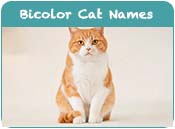
Bicolor Cat Names: Tuxedo, Van, Mitted and the White-Spotting Spectrum
By the iCatNames Editorial Team · Published
A bicolor cat is white plus one color — and the interesting half is the white. The pigment underneath can be black, blue, red, cream, or anything else, but what makes a cat “bicolor” is the white that interrupts it: a chest bib, four mittened paws, a blaze, or a coat so white that color clings to only the ears and tail. Naming one well means reading the white, not just the color it sits against.
This guide stays in that lane. We’re not naming by pigment shade here — we’re naming by pattern: how the white is arranged, how much of it there is, and what that arrangement looks like. A tuxedo wants a different name than a van, and a splotchy “cow” cat wants a different name again.
What actually makes a cat bicolor
The white in a bicolor coat comes from the white-spotting gene, written S and tied to the gene KIT. In cats the spotting is caused by an insertion of a feline endogenous retrovirus into KIT, which disrupts how pigment-producing cells migrate across the developing kitten’s skin. Wherever those cells don’t arrive, the fur grows in white. The gene is incompletely dominant, which is why two spotted parents don’t produce identical kittens: the amount of white varies enormously, even within a single litter.
Because the white is layered over whatever base color the cat already carries, “bicolor” isn’t a color so much as a layout. A black cat with the spotting gene becomes black-and-white; a red cat becomes red-and-white. The pattern is the same idea; only the pigment changes.
The grading scale, from a locket to a van
Cat fanciers grade white spotting on a rough scale. The British breeder Pat Turner laid out a widely cited version that runs from light to heavy, and it maps neatly onto the names people actually use:
| Grade / look | Where the white sits | Name energy |
|---|---|---|
| Locket / buttons (lowest) | A spot or two of white on a mostly colored cat | Subtle, ironic — a tiny mark, a big name |
| Mitted | White feet, sometimes chin and chest | Boots, Mittens, Slipper |
| Tuxedo | Colored coat, white bib, belly and paws (roughly a quarter white) | Formal wear — Tux, Jeeves, Bowtie |
| Bicolor / pied | About half-and-half, color and white in large blocks | Cow, magpie, spotty names |
| Harlequin | Mostly white with scattered patches of color | Confetti, playful, painterly |
| Van (highest) | White cat with color only on the head and tail | Cap-and-tail names, regal minimalism |
Turner’s grades name the same staircase: Grade 3 “Mitted,” Grade 5 “Saddle,” Grade 8 “Harlequin,” Grade 9 “Van.” You don’t need the numbers to use this — just look at your cat and find the row that matches. One important note: tuxedo and van are patterns, not breeds. A tuxedo can be a moggy from a shelter or a pedigreed Maine Coon; the van pattern shows up across breeds, even though it borrows its name from one.
Why the same gene gives a hundred different cats
Two things are worth understanding before you name. First, the white is unpredictable on purpose. Pigment cells migrate during fetal development, and where they happen to stop is partly chance, which is why even littermates with the same genes wear wildly different amounts of white — one a tidy tuxedo, the next a near-van. The grading scale describes the result, not a setting the breeder dialed in.
Second, the white sits on top of whatever the cat was going to be. A bicolor isn’t a new color; it’s a layout laid over an existing one, so the spotting gene can pair with a tabby, a solid, even a tortoiseshell underneath. When white spotting lands on a tortie, you get a calico — tortie-and-white. That’s why you’ll see Calico and Tortie in name lists near the bicolor ones: same white-spotting machinery, more colors underneath. For naming, the takeaway is simple — describe the arrangement of white you can see, and you’ll never be wrong about the pigment you can’t name.
The van pattern and Lake Van
The van pattern — a chalk-white cat with color restricted to the head and tail — takes its name from the Turkish Van, a breed associated with Lake Van in eastern Turkey. Vans earned the nickname “the swimming cats” for an unusual willingness to get in the water; the breed’s coat has a water-resistant texture, and the cats have been observed paddling around the lake that gives the pattern its name. When breeders say a cat is “van-patterned,” they mean that geographic look: head cap, colored tail, the rest white.
That gives van and near-van cats a distinct naming register — spare, a little regal, often geographic or elemental. Names that lean into the “mostly white with one bold mark” idea:
- Van and Vanna — the obvious, and not bad for it
- Pearl, Ivory, Snow, Snowy, Frost — for the white field
- Cloud, Storm, Eclipse, Crescent — one dark mark on a pale sky
- Captain, Skipper, Sailor — a nod to the swimming Vans of the lake
Tuxedo names: dress the part
The tuxedo is the most recognizable bicolor: dark coat, white shirtfront, white paws, often a white chin. The word itself is surprisingly young. The linguist Cecily Raysor Hancock could trace “tuxedo cat” in print no further back than the early 1980s in America — the cats are ancient, but the cute label is recent. The look maps directly to formal menswear, so formal-wear names land cleanly.
Formal and dapper
- Tux and Tuxedo, or the softer Tuxie
- Bowtie, Spats, Topper — the accessories of the black-tie kit
- Jeeves, Alfred, Reginald (call him Reggie), Bertie — the butler register, all crisp white collar
- Gatsby for old-money glamour; Chaplin for the silent-film tramp in tails
- Bond for the dinner jacket; Dapper if you want to say the quiet part loud
Black-and-white classics
- Oreo, Domino, Blackjack, Checker / Checkers — the two-tone games and snacks
- Pepper with Salt, or Inky for the dark half
- Yin and Yang for a bonded pair, or one cat who contains both
- Socks / Sox and Boots for the white feet that name themselves
Pop culture supplies the patron saints here: Felix the Cat and Sylvester are both tuxedos, and both are why so many people picture “cartoon cat” as black-and-white before they picture anything else.
Mitted: when the white is just the feet
Lower on the scale sits the mitted cat — mostly colored, with white restricted to the paws, like a cat that stepped in paint. The look is familiar from the Ragdoll and the Birman, both of which carry white “gloves” or “mitts” as part of the breed standard, though the same toe-white turns up on plenty of mixed-breed cats too. Mitted is understatement, so understated names suit it: name the feet and stop there.
- Mittens, Boots, Gloves, Tippy, Whitepaw — literal and affectionate
- Socks and Sox — the most-used cat name for white feet, and earned
- Ragdoll as a nod to the breed that made the mitts famous
Cow, magpie and spotty names
Move up the grading scale to the half-and-half and high-white cats and the look changes from “dressed up” to “spattered.” A cat with large irregular blocks of color on white reads as a tiny dairy cow; one with scattered flecks reads as a magpie or a harlequin. The names get playful:
- Moo, Cow, Holstein, Bessie, Clarabelle — the full bovine set
- Patches, Patch, Patchy, Splotch, Blotch — for the irregular blocks
- Dot, Dottie, Sprinkles, Speckles, Freckles, Polka — for the speckled, high-white cats
- Magpie (and the nickname Maggie), Pie, Marble / Marbles — the bird the magpie pattern is named for, a black-and-white corvid with a reputation for stealing bright objects
- Panda, Orca, Shamu, Penguin, Puffin, Skunk, Zebra — the animal kingdom’s other famous two-tones
For the masked, bandit-faced cats — color over the eyes and ears, white below — the heist register works: Bandit, Zorro, Phantom, Raccoon.
Worth a fine distinction: magpie and harlequin aren’t quite the same. A magpie cat is randomly daubed — black splotches dropped anywhere on white, like the bird. A true harlequin is a high-white cat carrying maybe a fifth to two-fifths of its color in distinct patches, often with a colored tail and a few body spots. The harlequin’s scattered-on-canvas look invites the painterly register: Splotch, Splatter, Mosaic, Confetti, or an artist — Pollock for the spatter, Picasso or Matisse for the bold shapes.
Two famous bicolors, for the record
Two of these names come with a real cat attached.
Socks was the Clintons’ tuxedo cat — a stray adopted in 1991 in Little Rock, Arkansas, named for his white paws, and the family cat in the White House from 1993 to 2001. He outlived the administration, moved in with a former Clinton secretary, and was euthanized on 20 February 2009 after developing jaw cancer, at roughly eighteen. A textbook tuxedo, right down to the namesake feet — the white paws came first, the name second, which is exactly how good bicolor names tend to happen.
Simon was the ship’s cat aboard the Royal Navy sloop HMS Amethyst. During the 1949 Yangtze Incident the ship was hit repeatedly; Simon was wounded by shrapnel, kept the rat population down, and steadied morale among the crew. He was awarded the Dickin Medal — the animal equivalent of a gallantry award — and remains the only cat ever to receive it. He died on 28 November 1949, shortly after the ship returned, and was buried with military honors. Simon carries real weight as a name — and for a bonded pair or a cat with a maritime story, Amethyst, after his ship, makes a quiet companion to it.
Match the name to the amount of white
The single most useful move is to let the grade pick the register. Three quick reads:
- Tuxedo (low-to-medium white, dark with a white front): dress it up. Jeeves, Gatsby, Bowtie, Bond — the cat already looks like it’s going somewhere formal.
- Mitted (white feet, little else): name the feet. Mittens, Boots, Socks, Tippy — understatement that fits an understated pattern.
- Van or harlequin (mostly white, one bold mark or a scatter): go elemental or playful. Van, Eclipse, Confetti, Panda.
Naming a bicolor pair
Two-tone cats almost beg to be adopted in twos, and the contrast in the coat gives you a built-in theme. Complementary names beat matching ones — they let each cat keep its own identity while pointing at the shared look:
- Pepper and Salt, or Inky and Snowy — the dark half and the light half, named separately
- Yin and Yang — opposites that need each other
- Lady and the formal set — pair a tuxedo Jeeves with a Duchess or an Earl, and the household runs on its own little staff
- Cookie and Brownie, or Sundae and Meringue — dessert pairs where one reads dark, one reads pale
A nice trick for the formal-name household: cast by role. A tuxedo earns the title — Sir, Baron, Noble, Countess — while a high-white companion gets something lighter, and the contrast in coats becomes a contrast in rank.
And if your cat’s “bicolor” is really just a single white locket on a dark chest, lean into the joke — a one-button cat named Dapper or Bond is funnier than a cat in a full tuxedo wearing the same name.
A worked example. Say you adopt a black cat with four white feet, a white bib, and a single white blot over one eye. You could name the color (black), but the white is what people will notice first. Lead with the strongest mark: the off-center eye-patch makes Patches or Splotch read instantly, while the formal bib pushes toward Tux or Bowtie. Pick the one feature a stranger would mention unprompted, and name that.
Here’s the test worth running before you commit: say the name across a room while looking at the cat. If a stranger could glance at the coat and see why the name fits — the white feet, the cow-spots, the bare-faced van cap — the pattern is doing the work for you. That’s the whole point of naming by the white.