
Aegean Cat Names, Names For Greek Aegean Kittens
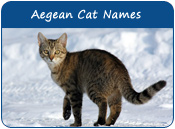
The Aegean is the only domestic-cat landrace native to Greece. Cats arrived in the Cycladic Islands during the Bronze Age and have been living there ever since — semi-feral, semi-companion, working alongside fishermen on Andros, Delos, Mykonos, Naxos, Santorini, and the smaller islands of the Aegean Sea. They are one of the few feline populations that genuinely descend from a continuous regional gene pool rather than a deliberate breeding program.
No major fancier registry has formally recognized the Aegean. The CFA, TICA, and GCCF list pages do not include it. The Greek Cat Fancy began documentation efforts only in the early 1990s, and the breed remains primarily a local heritage population rather than a show pedigree. In Greece, Aegean cats are considered a national treasure — visible in coastal towns and around fishing harbors, where they have been kept for rodent control near grain stores and dried-fish racks for centuries.
The coat is medium-length, always bicolor or tricolor, with white covering between 25 and 90 percent of the body. Solid colors are not part of the standard. Eyes are almond-shaped, ranging from green to blue to yellow. The breed has retained an unusual affinity for water — fishing-port heritage rather than novelty — and most lines are remarkably free of inherited disease, since natural selection rather than line-breeding shaped the population.
Name suggestions follow the heritage directly. Cycladic islands: Naxos, Mykonos, Santorini, Delos, Andros, Paros. Greek mythology: Athena, Apollo, Calypso, Helios, Selene. Greek words: Thalassa (sea), Zoe (life), Eleni (light). Fishing-port wink: Captain, Sailor, Salt.
Name Ideas from This Breed Collection
An introductory selection from this editorial collection, ordered by catalog ID. This is not a popularity ranking. Browse the alphabetical list below for all 129 options.
Meanings, origins and pronunciations appear only for records with checked sources. Blank fields have not been verified. Gender and collection labels are browsing choices.
| Name | Meaning | Gender | Origin |
|---|---|---|---|
| Adonis | Male | ||
| Aeolus | Unisex | ||
| Alexander | Male | ||
| Alissa | Female | ||
| Anastasia | Female | ||
| Antigone | Female | ||
| Aphrodite | Female | ||
| Apollo | Male | Greek mythology, Latinized form | |
| Apollonia | Female | ||
| Ares | Unisex | ||
| Argos | Unisex | ||
| Arianna | Female | ||
| Artemis | Male | ||
| Athena | Female | Greek mythology | |
| Athene | Unisex | ||
| Atlas | Male | ||
| Aurora | Dawn | Female | Latin |
| Bacchus | Male | ||
| Calix | Male | ||
| Calliope | Female | ||
| Camilla | Female | ||
| Ceres | Female | ||
| Chloe | Green shoot; new plant growth | Female | Greek |
| Christina | Female | ||
| Corrina | Unisex | ||
| Cosmo | An Italian variant of Cosimo | Male | Italian |
| Damian | Male | ||
| Danae | Female | ||
| Demeter | Female | ||
| Diomedes | Unisex | ||
| Dionysus | Unisex | ||
| Dorothy | Female | ||
| Ebony | Female | ||
| Echo | Male | ||
| Electra | Female | ||
| Eleni | Female | ||
| Eros | Male | ||
| Evangeline | Female | ||
| Gaia | Female | ||
| Ganymede | Unisex | ||
| Gemini | Male | ||
| Hades | Male | ||
| Hecate | Unisex | ||
| Hector | Male | ||
| Helena | Female | ||
| Helios | Unisex | ||
| Hera | Female | ||
| Hermes | Male | ||
| Hermione | Female | ||
| Hestia | Female |
129 names found. Page 1 of 3.
Frequently Asked Questions
Is the Aegean a recognized breed?
Not by the major international registries. The CFA, TICA, GCCF, and FIFe do not list the Aegean as a recognized breed. The Greek Cat Fancy began breed documentation in the early 1990s, and breeders within Greece work with national associations to preserve the population, but the Aegean remains primarily a heritage landrace rather than a competition pedigree. Owners should expect more variation in physical type than they would see in a CFA-recognized breed.
Where did Aegean cats come from?
Cats arrived in the Cycladic Islands of Greece during the Bronze Age — likely brought by Phoenician and early Greek traders alongside grain — and have lived there continuously since. They are visible today on Andros, Delos, Mykonos, Naxos, Santorini, and many smaller islands. Western Turkish coastal populations are sometimes included in the breed range. Genetic isolation across the islands has shaped the breed without any deliberate breeder program — natural selection alone.
Are Aegean cats really good swimmers?
They have a documented affinity for water, shaped by centuries of living alongside Greek island fishermen. Fishing-port populations would gather around docked boats waiting for the day's catch, and the trait of being unbothered by water is well-attested in the breed. This is not the same as the Turkish Van's actively-seek-water behavior — Aegeans are comfortable around water rather than drawn to it — but the contrast with most cat breeds is real.
Are Aegean cats healthy?
Generally, yes. Because the breed developed under natural selection rather than selective breeding, the population is largely free of the inherited conditions common in heavily line-bred pedigrees. Heart, kidney, and bone-cartilage disorders that affect some recognized breeds are not documented in the Aegean. The trade-off is greater variation in appearance and temperament between individual cats — there is no tightly-defined breed standard to enforce uniformity.
What names suit an Aegean cat?
Geographic and mythological names are the strongest fits. Cycladic islands: Naxos, Mykonos, Santorini, Delos, Andros, Paros, Milos, Ios. Greek mythology: Athena, Apollo, Calypso, Persephone, Helios, Selene, Iris. Greek-language picks: Thalassa (sea), Zoe (life), Eleni (light), Dimitra (after Demeter, goddess of harvest). For the breed's working heritage: Salt, Sailor, Anchor, Captain.