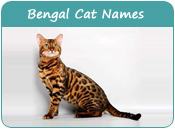
Bengal Cat Names: Male, Female, Snow and Silver Ideas
Written by iCatNames Editorial Team · Reviewed by Marvin · Reviewed
Bengal naming searches often split by sex and visible coat: male, female, snow, and silver. TICA’s breed material distinguishes patterned coats and explains that breeders use snow for colorpoint-derived pale coats, while silver Bengals have pale backgrounds with darker patterning.
Those terms describe appearance within a breed standard; they do not make a pet a wild animal or determine temperament. The 36 candidates below keep gender and coat routes available while testing each as an ordinary household call.
Male Bengal Calls with Distinct Openings
This group favors established male records with different first sounds and lengths. None claims that a male Bengal must sound forceful, athletic, or regal.
- Atlas — Here Atlas points toward a mythic burden-bearer and map-book association. This Bengal candidate keeps registered color, observed appearance, and personality as separate questions. Compare the first sound with food words and household commands.
- Cairo — Cairo reaches the male call group through the Egyptian capital and a two-beat place call. Verify cultural context, settle one pronunciation, and spend an ordinary week checking whether the Bengal call remains comfortable at every volume.
- Cash — Cash enters the Bengal set through a clipped established personal and word name. The reference can complement rosettes or family history without turning a domestic breed into a wild-animal character. Check Cash against every current pet call.
- Chase — For a Bengal household, Chase adds an action word already used as a personal name. Place the complete name on a pretend clinic form and predict its nickname. Keep both only when their rhythms remain easy during routine care.
- Diesel — The Bengal-specific discussion around Diesel begins with an industrial word with two firm beats. That is narrower than promising speed, dominance, or mischief. Call Diesel through a doorway and record the syllables listeners recover.
- Finn — Choose Finn from a compact human call documented across several traditions, not from a wild-pet stereotype. Its male call role should make sense after kitten pattern and energy change. Public introductions provide a useful second test.
Atlas and Cairo carry large geographic or mythic references; Cash and Finn are compact human-name forms; Chase and Diesel lean toward action or machinery. That variety matters because a list composed only of aggressive words would turn breed marketing into a personality assumption.
Run the first-sound test beside family vocabulary. Cash and Chase are acoustically close and should not survive together. Atlas may shorten to Attie, Cairo to Cai, and Diesel to Dee. Finn resists shortening but may collide with a person. The chosen male call should work for a quiet adult as comfortably as for an active kitten.
Female Bengal Names without a Predetermined Persona
Female searches need more than a row of princess titles. These candidates range from human forms to sky, month, and nature references, allowing sound and household story to lead.
- Alexa — Here Alexa points toward an established feminine form with a clear three-beat rhythm. This Bengal candidate keeps registered color, observed appearance, and personality as separate questions. Compare the first sound with food words and household commands.
- April — April reaches the female call group through a month word forming an upbeat two-syllable call. Verify cultural context, settle one pronunciation, and spend an ordinary week checking whether the Bengal call remains comfortable at every volume.
- Astra — Astra enters the Bengal set through a star-related Latin-rooted form. The reference can complement rosettes or family history without turning a domestic breed into a wild-animal character. Check Astra against every current pet call.
- Ayla — For a Bengal household, Ayla adds an established personal name with multiple linguistic routes. Place the complete name on a pretend clinic form and predict its nickname. Keep both only when their rhythms remain easy during routine care.
- Cassidy — The Bengal-specific discussion around Cassidy begins with a surname-derived personal name with a natural short form. That is narrower than promising speed, dominance, or mischief. Call Cassidy through a doorway and record the syllables listeners recover.
- Nala — Choose Nala from a widely recognized personal and fictional-lion name, not from a wild-pet stereotype. Its female call role should make sense after kitten pattern and energy change. Public introductions provide a useful second test.
Alexa and Cassidy are long enough to invite Lexi or Cass. April and Nala have two clear beats. Astra and Ayla differ by only one central consonant-vowel movement, so listening from another room is more useful than comparing spelling.
Public familiarity varies. Alexa may trigger thoughts of a voice assistant; Nala may be strongly tied to a film character. Those associations are not automatic disqualifiers, but the family should want them rather than discover them after records are printed. A female Bengal name can be ordinary, historical, or celestial without proving anything about behavior.
Pattern, Motion, and Big-Cat References
Bengal coats invite spotted, striped, and wild-cat vocabulary. Use such references narrowly: domestic Bengals are domestic cats, and a dramatic pattern does not confer a hunting identity.
Keep visual resemblance separate from species claims
- Flint — Flint enters the Bengal set through a dark hard stone and spark image. The reference can complement rosettes or family history without turning a domestic breed into a wild-animal character. Check Flint against every current pet call.
- Hunter — For a Bengal household, Hunter adds an established surname and activity word. Place the complete name on a pretend clinic form and predict its nickname. Keep both only when their rhythms remain easy during routine care.
- Leo — The Bengal-specific discussion around Leo begins with the Latin lion word and zodiac label. That is narrower than promising speed, dominance, or mischief. Call Leo through a doorway and record the syllables listeners recover.
- Lynx — Choose Lynx from a wild-cat genus used here as visual wordplay, not from a wild-pet stereotype. Its pattern and motion role should make sense after kitten pattern and energy change. Public introductions provide a useful second test.
- Max — Here Max points toward a compact established personal name. This Bengal candidate keeps registered color, observed appearance, and personality as separate questions. Compare the first sound with food words and household commands.
- Osiris — Osiris reaches the pattern and motion group through an Egyptian deity reference with three audible parts. Verify cultural context, settle one pronunciation, and spend an ordinary week checking whether the Bengal call remains comfortable at every volume.
Flint and Max are short but semantically very different. Hunter and Lynx make the strongest animal or activity claims, so they need the clearest boundary: the words are references, not biological descriptions of a domestic cat. Leo is familiar and may be crowded; Osiris brings history that should be explained accurately.
Look at pattern type without inventing a standard classification. A dark rosette may suggest Flint, while a high-contrast outline may remind someone of Lynx. If the registered coat description matters, consult breeder paperwork or a registry source. The name can remain playful even when the technical label is uncertain.
Place and Established Personal Names for a Broader Story
A Bengal does not need a leopard reference. Place and personal names give the cat an identity that can outlast changing coat contrast, age, and kitten behavior.
- Cleopatra — Cleopatra enters the Bengal set through the Ptolemaic Egyptian ruler and a long formal call. The reference can complement rosettes or family history without turning a domestic breed into a wild-animal character. Check Cleopatra against every current pet call.
- Dakota — For a Bengal household, Dakota adds a place and Indigenous nation name requiring respectful context. Place the complete name on a pretend clinic form and predict its nickname. Keep both only when their rhythms remain easy during routine care.
- Delta — The Bengal-specific discussion around Delta begins with a river-landform word and established personal name. That is narrower than promising speed, dominance, or mischief. Call Delta through a doorway and record the syllables listeners recover.
- Farrah — Choose Farrah from an established feminine personal name, not from a wild-pet stereotype. Its place and personal name role should make sense after kitten pattern and energy change. Public introductions provide a useful second test.
- Halle — Here Halle points toward a place and personal-name form. This Bengal candidate keeps registered color, observed appearance, and personality as separate questions. Compare the first sound with food words and household commands.
- Zoe — Zoe reaches the place and personal name group through a Greek-rooted personal name associated with life. Verify cultural context, settle one pronunciation, and spend an ordinary week checking whether the Bengal call remains comfortable at every volume.
Cleopatra is the most historically specific and the most likely to shorten. Dakota carries Indigenous and geographic contexts that should not be treated as an empty adventurous aesthetic. Delta names a landform; Halle and Farrah are human forms; Zoe supplies the shortest bright ending.
Ask what the household can explain without improvisation. A travel memory can support Delta or Halle. A historical interest can support Cleopatra. Farrah or Zoe may simply be a sound preference. The broader route is useful because it lets breed be one part of the cat’s record rather than the entire identity.
Snow Bengal Names for Pale Warm Backgrounds
Snow is a breeder term connected with colorpoint ancestry, not a claim that every pale Bengal is pure white. These names follow cool landscapes and luminous materials while leaving the exact registered color to documentation.
- Frost — Frost reaches the snow color group through a pale crystalline layer. Verify cultural context, settle one pronunciation, and spend an ordinary week checking whether the Bengal call remains comfortable at every volume.
- Glacier — Glacier enters the Bengal set through a large body of compacted ice. The reference can complement rosettes or family history without turning a domestic breed into a wild-animal character. Check Glacier against every current pet call.
- Moonstone — For a Bengal household, Moonstone adds a light-reflecting feldspar gemstone name. Place the complete name on a pretend clinic form and predict its nickname. Keep both only when their rhythms remain easy during routine care.
- Pearl — The Bengal-specific discussion around Pearl begins with a lustrous pale gem and personal name. That is narrower than promising speed, dominance, or mischief. Call Pearl through a doorway and record the syllables listeners recover.
- Snowy — Choose Snowy from a direct softened snow adjective, not from a wild-pet stereotype. Its snow color role should make sense after kitten pattern and energy change. Public introductions provide a useful second test.
- Yuki — Here Yuki points toward a Japanese personal-name form with snow among its readings. This Bengal candidate keeps registered color, observed appearance, and personality as separate questions. Compare the first sound with food words and household commands.
Frost and Glacier lean blue-white; Pearl and Moonstone allow warm shimmer; Snowy is direct; Yuki carries language context. That range better matches how snow Bengals may show ivory, cream, or tan backgrounds rather than a blank white field.
Use registry paperwork when technical color matters. A naming guide cannot distinguish seal lynx point, seal mink, or seal sepia from a casual photograph. Choose the call for its honest visual or family connection, and describe the coat in ordinary terms unless a reliable record supports the formal label.
Silver Bengal Names for Cool Contrast and Reflection
TICA describes silver Bengals with grey to nearly white backgrounds and dark patterning. The following calls draw on cool light, mist, and metal without asserting a precise genotype.
- Cloud — For a Bengal household, Cloud adds a soft pale background image. Place the complete name on a pretend clinic form and predict its nickname. Keep both only when their rhythms remain easy during routine care.
- Misty — The Bengal-specific discussion around Misty begins with a suspended-water and low-contrast landscape image. That is narrower than promising speed, dominance, or mischief. Call Misty through a doorway and record the syllables listeners recover.
- Opal — Choose Opal from a gemstone with shifting color play, not from a wild-pet stereotype. Its silver color role should make sense after kitten pattern and energy change. Public introductions provide a useful second test.
- Silver — Here Silver points toward the direct metal and coat-color word. This Bengal candidate keeps registered color, observed appearance, and personality as separate questions. Compare the first sound with food words and household commands.
- Slate — Slate reaches the silver color group through a cool dark-grey stone contrast. Verify cultural context, settle one pronunciation, and spend an ordinary week checking whether the Bengal call remains comfortable at every volume.
- Sterling — Sterling enters the Bengal set through a polished silver standard and personal-name form. The reference can complement rosettes or family history without turning a domestic breed into a wild-animal character. Check Sterling against every current pet call.
Silver is the most literal. Sterling makes the metal reference less direct; Slate focuses on dark pattern; Cloud and Misty emphasize pale ground; Opal introduces color shift. Compare each against the coat in indirect daylight, since warm indoor bulbs can make a cool background appear beige.
Then ignore the coat and test the call. Cloud and Slate are one beat; Silver and Sterling share an opening and should not remain together; Misty and Opal are familiar two-beat names. A technically accurate color word is still a poor household choice when it collides with a person, pet, or frequently used noun.
Build One Bengal Shortlist across Sex and Coat Routes
Select two calls from the relevant gender route, two from pattern or place, and two from the observed coat route. Add likely nicknames and the exact one-sentence reference for each. Remove any candidate that requires describing the cat as savage, dominant, hyperactive, or wild. Those labels are not naming evidence.
Test the remaining calls for seven days. Use ordinary volume, multiple rooms, carrier practice, and a clinic-style introduction. If formal color classification matters, verify it through reliable breed documentation; the name can still use a looser family image. Link the winning call to the generic Bengal collection rather than creating duplicate pages for every modifier.
Sources and Further Reading
Sources support factual context; suggested names and editorial grouping are produced by iCatNames.