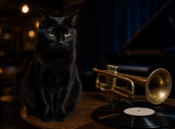
Jazz and Blues Cat Names: 130+ Cool Cat Ideas from the Greats
By the iCatNames Editorial Team · Published
There is one naming theme that turns the cat itself into the punchline, and it has nothing to do with how your cat looks. In the jazz argot that came up through Harlem in the 1930s and 1940s, “cat” was the word for a musician, and a sharp, switched-on person was a “hep cat” or, a little later, a “cool cat.” Cab Calloway codified the vocabulary in his 1938 Cat-ologue: A Hepster’s Dictionary, and linguists have traced the slang back further still, to the Wolof word katt for an accomplished singer or griot. So when you call a cat after a jazz musician, you are not borrowing a theme – you are stating a fact. The genre already decided that the coolest people in the room were cats.
Beyond the pun, jazz and blues are a deep, specific well to draw from. The music gave us a parade of one-word nicknames built for shouting across a room – Satchmo, Bird, Duke, Trane, Sassy – plus a whole working vocabulary of swing, scat, and the blue note that translates cleanly onto a striped tail or a velvet-grey coat. A blues-named cat reads as smoky and a little aloof; a bebop-named cat reads as fast and unpredictable. Below are the names sorted the way a record-store crate is sorted: by scene, by player, by sound, and by color.
The “Cool Cat” Vocabulary: Slang and Scat
Start with the words the music made up about itself. These suit a cat with attitude rather than a cat with a pedigree, and several of them are literally onomatopoeia for the sound.
- Jazz — the genre name itself, blunt and confident; for a cat that improvises around the house and never plays the same route twice.
- Scat — wordless vocal improvisation, the syllables Ella Fitzgerald spun into solos; a fitting tag for a chatty, vocal cat that answers you in its own nonsense language.
- Bebop — the fast, angular 1940s style of Parker and Gillespie; for a high-RPM kitten that takes the stairs at full tilt.
- Boogie — from boogie-woogie, the rolling left-hand blues piano style; an easy call for a cat that zooms at 2 a.m.
- Riff — a short repeated musical phrase; good for a cat with one signature move it runs on a loop.
- Mojo — a blues talisman and the charm in Muddy Waters’ “Got My Mojo Working”; for a cat that clearly believes it has magic powers.
- Groove — the locked-in rhythmic pocket a band settles into; an unfussy name for a mellow, steady housemate. (Not in our name dictionary, but it stands on its own.)
- Swing — the rhythmic feel that defined the big-band era; suits a cat with a confident, rolling walk.
- Jive — the slang itself, the talk of the Harlem scene; for a cat that always looks like it is up to something.
Jazz Legends: First Names and Nicknames
The giants of jazz mostly went by single names or nicknames – the music ran on familiarity. These carry real weight, so pick one whose temperament matches the cat.
- Duke — Duke Ellington, the bandleader-composer whose orchestra defined elegant jazz for half a century; for a cat that holds itself like royalty and expects the good chair.
- Ella — Ella Fitzgerald, the First Lady of Song, with a three-octave range and peerless scat; a graceful name for a sweet-voiced female cat.
- Louis — Louis Armstrong, the trumpeter and gravel-voiced singer who made the soloist the center of jazz; warm and foundational.
- Satchmo — Armstrong’s nickname (short for “Satchel Mouth”); a big friendly name for a big friendly cat with a loud opinion.
- Pops — Armstrong’s other nickname and the one musicians used affectionately; a warm fit for a senior gentleman cat.
- Miles — Miles Davis, the trumpeter who reinvented his sound every decade; for a cool, restless, hard-to-read cat.
- Bird — Charlie Parker’s nickname and the engine of bebop on alto sax; a sly choice for a cat that hunts.
- Charlie — Parker’s given name; a soft, everyday handle that still carries the legend underneath.
- Dizzy — Dizzy Gillespie, the trumpeter with the bent horn and puffed cheeks; for a goofy, dizzying, acrobatic cat.
- Monk — Thelonious Monk, the pianist of angular, off-kilter genius; for a cat that does everything its own strange way.
- Coltrane — John Coltrane, the saxophonist of restless spiritual intensity; a strong, dignified name, especially for a black cat.
- Trane — Coltrane’s nickname, short and forward-moving; for a cat with somewhere to be. (Plain text; no dictionary page.)
- Nina — Nina Simone, the singer-pianist whose voice could turn from velvet to thunder; for an intense, expressive cat.
- Sarah — Sarah Vaughan, the vocalist with operatic control known as “The Divine One”; elegant and a little grand.
- Sassy — Vaughan’s nickname, given for a personality that matched the swagger of her voice; built for an opinionated cat.
- Mingus — Charles Mingus, the volcanic bassist-composer; a heavyweight name for a large, vocal, dramatic cat.
Blues Royalty: Names with Grit
The blues came first and named itself in titles – King, Empress, Wolf. These names carry smoke and history, and most suit a cat with presence rather than a kitten.
- Bessie — Bessie Smith, the Empress of the Blues, a contralto so powerful she scorned the microphone; commanding, for a cat that owns a room.
- Muddy — Muddy Waters, who electrified Delta blues in Chicago; an earthy, affectionate name that begs to be said in a warm growl.
- Wolf — from Howlin’ Wolf, the towering bluesman with the rumbling voice; for a big, broad-shouldered cat with a deep meow.
- Etta — Etta James, whose voice moved between blues, soul, and rock with raw feeling; for a cat with a soulful stare.
- Dinah — Dinah Washington, the “Queen of the Blues” with crisp, cutting diction; for a poised, precise female cat.
- Ray — Ray Charles, who fused gospel and blues into soul; a short, friendly name with deep roots.
- King — for B.B. King and the whole lineage of blues kings; a plain, regal handle for a cat that rules the household.
- Lucille — the name B.B. King gave every one of his guitars, after a 1949 nightclub fire in Twist, Arkansas, that broke out over a woman named Lucille; a name forged in a real story, for a cherished cat.
- Billie — Billie Holiday, “Lady Day,” whose phrasing bent every note into feeling; tender and a little melancholy.
- Lady — from Holiday’s nickname Lady Day; refined and understated for a dignified female cat.
- Chet — Chet Baker, the trumpeter and singer whose cool, fragile tone defined West Coast jazz; for a soft-spoken, good-looking cat.
Instruments, Keys, and the Tools of the Trade
If you want jazz without the weight of a legend’s name, the instruments and studio vocabulary make clean, neutral choices.
- Trumpet — the lead brass voice of jazz, bright and carrying; for a cat with a loud, declarative meow.
- Brass — the whole horn family in one word; warm-toned, good for a ginger or buff-colored cat.
- Cello — the deep, singing string voice; for a cat with a low, resonant purr.
- Keys — the piano, the harmonic backbone of jazz; tidy and modern.
- Ivory — the old piano keys, and a natural fit for a white or ivory cat.
- Sax — the saxophone, the breathy heart of bebop and the blues solo; cool and concise. (Plain text; no dictionary page.)
- Reed — the thin slip of cane that gives a sax or clarinet its voice; understated, good for a slender cat. (Plain text.)
- Soul — the genre born from gospel and blues, and the word for everything they were chasing; deep and simple.
- Harmony — the stacked notes under a melody; a calm name for one of a bonded pair.
- Melody — the tune itself, the line you hum; sweet without being saccharine.
Cool, Smooth, and a Little Aloof
Jazz and blues run on texture – the velvet of a ballad, the smoke of a late set, the mellow of a slow blues. These names lean on temperament and mood, and they fit the kind of cat that watches the room from a high shelf.
- Cool — the temperature and the attitude both; the most literal “cool cat” name there is.
- Mellow — relaxed and unhurried, the feel of a slow blues; for a cat with no urgent business.
- Velvet — the texture of a crooner’s voice and a plush coat; for a cat that is all softness.
- Satin — sleek and shining, a half-step from velvet; good for a glossy short-haired cat.
- Smoky — the haze of a jazz club and the gray of a coat; an easy fit for a smoke-colored cat.
- Smoke — the noun version, for a gray cat that drifts through rooms without a sound.
- Misty — after the Erroll Garner jazz standard “Misty”; soft and atmospheric for a pale gray cat.
- Shadow — for the black cat that materializes at the edge of the lamplight, like a player half-lit on the bandstand.
By Coat Color: Black, Blue, and the Blue Note
The blues practically demand to be applied to a slate-grey cat – the genre is named after the color of a mood. A “blue note” is the slightly flattened pitch that gives the music its ache, and Ellington’s “Mood Indigo,” Monk’s “’Round Midnight,” and Davis’ Kind of Blue all live in that register.
For a black cat:
- Midnight — the hour of the last set, and a crisp name for a jet-black cat; Monk’s “’Round Midnight” is the patron tune.
- Coal — deep matte black, the color of a cat that disappears against a dark floor.
- Inky — black with a little mischief built in; for a playful dark kitten.
- Onyx — burnished black stone, for a sleek, glossy coat.
- Ebony — rich dark wood and one half of every piano keyboard; a dignified black-cat name.
For a blue or slate coat:
- Indigo — straight from Ellington’s “Mood Indigo”; the definitive cool-blue jazz name.
- Blue — the genre and the mood in one syllable; ideal for a Russian Blue or any slate-coated cat.
- Cobalt — a deeper, richer blue, for a cool-toned grey coat.
- Sapphire — blue with a gleam, suited to a grey cat with striking eyes.
- Slate — flat blue-grey, an understated color name.
- Pewter — dull silvery grey, for a soft-toned coat.
- Sterling — brighter silver, for a cat with a shining grey coat.
- Storm — grey with drama, for a moody silver cat.
For a white or ivory cat:
- Pearl — soft white with a sheen; quietly elegant.
- Snowy — bright clean white, plain and cheerful.
- Frost — cool white with an edge.
For a ginger or buff cat:
- Brassy — the brass section in coat form; bold and golden, with a hint of swagger.
- Copper — warm reddish-orange, for a deep ginger.
- Amber — glowing gold, for a sunlit orange cat.
- Honey — soft warm gold, for a buff or cream-orange cat.
- Marmalade — classic ginger tom territory; friendly and bright.
- Saffron — deep gold with spice, for a vivid ginger.
The Speakeasy Set: Whiskey, Smoke, and Late Nights
Jazz and blues were after-hours music, played in clubs thick with smoke and tied to the cocktail. These names lean into that late-night glamour for a cat with nocturnal habits.
- Whiskey — the drink of the smoky club; for an amber-coated cat or one with a slow, deliberate manner.
- Bourbon — warmer and sweeter than whiskey, and a nod to New Orleans; for a Southern-soft ginger cat.
- Jelly — from Jelly Roll Morton, the early New Orleans pianist who claimed to have invented jazz; a sweet name with a wink.
- Fats — for Fats Waller and Fats Domino, the rolling, joyful piano men; an affectionate pick for a round, happy cat.
- Waller — Fats Waller’s surname, stride-piano royalty; a less obvious nod for a playful cat.
- Domino — for Fats Domino and, conveniently, for a tuxedo cat.
- Pepper — for saxophonist Art Pepper, and a tidy name for a salt-and-pepper coat.
Pairs and Trios: Naming Two Cats Together
Jazz history is full of duos and rhythm sections, which makes it a rich source for bonded pairs. Lean on the players who actually recorded together, or on two halves of one idea.
- Ella and Louis — Fitzgerald and Armstrong cut beloved duet albums; the warmest pairing on this list.
- Duke and Ella — Ellington and Fitzgerald collaborated repeatedly; a regal, elegant pair.
- Miles and Coltrane — bandleader and saxophonist on the records that changed jazz; for a cool pair, one watchful and one intense.
- Bird and Dizzy — Parker and Gillespie, the two architects of bebop; for two fast, playful cats that egg each other on.
- Bessie and Billie — two queens of vocal blues a generation apart; for a pair of dramatic divas.
- Velvet and Satin — two textures of one smooth idea; for matched plush coats.
- Indigo and Midnight — the blue note and the small hours; ideal for a grey cat and a black cat raised together.
- Salt and Pepper — the visual pun made literal; pair a pale cat with a dark one.
Finding the Right Note
The best of these names do two jobs at once: they tip a hat to the music and they describe the actual cat in the room. A grey shorthair that watches the room from a height is already living the part of Indigo or Miles; a loud orange tom who announces every meal is a born Satchmo or Brassy. Say the name down a hallway a few times before you commit – jazz nicknames earned their lives by being shouted from a bandstand, and a good cat name has to survive the same test at the back door. Whichever you pick, you are saluting a tradition that decided, long before you did, that the coolest figure in any room was the cat.