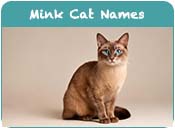
Mink Cat Names: 110+ Warm, Aqua-Eyed Picks for a Tonkinese (Natural, Champagne, Blue & Platinum)
By the iCatNames Editorial Team · Published
Stand a Tonkinese mink kitten next to its parents and you can read the genetics with your eyes. One grandparent line gives the pale-bodied, dark-masked, blue-eyed Siamese look. The other gives the deep, even, golden-eyed Burmese sepia. The mink is what happens exactly between them: a warm, hand-rubbed mid-tone body, points that are present but soft rather than sharp, and the feature breeders will mention before anything else — eyes the color of sea glass. That aqua is not a marketing word. It is the visible signature of a specific genetic in-between, and it is the heart of this whole article.
So “mink” here is not a vague pretty label. It is a real coat pattern with a real cause, and the names below are built around it: the luxe-fur words it borrows, the warm neutral browns and greys it actually wears, and the aqua eyes that mark it. First, the part most name guides skip — what mink actually is.
What “mink” really means: the cat in the middle
Coat color in this group of cats is controlled by a stretch of DNA geneticists call the C-locus, part of the albino series. Most of the alleles there don’t make a cat fully albino; they make pigment temperature-sensitive, so color develops more strongly on the cooler points of the body — ears, face, feet, tail — than on the warmer torso. Two alleles matter for our story:
- cs — the Siamese allele. Two copies (cs/cs) give the point pattern: a pale body, strong dark points, and blue eyes. High contrast.
- cb — the Burmese allele. Two copies (cb/cb) give the sepia pattern: a rich, even, warm-brown body with only a faint shadow of points, and gold-to-yellow eyes. Low contrast.
The two alleles are co-dominant — neither one fully overrides the other. So when a cat inherits one of each (cb/cs), it lands in the middle. That heterozygote is the mink: medium contrast, a warm mid-tone body that grades gently into the points, and — because the eye color tracks the pattern — aqua eyes that are neither Siamese blue nor Burmese gold. A mink is, quite literally, the cat that is half-Burmese and half-Siamese in coat expression.
Two practical things follow from this. Tonkinese kittens are born much paler than they will end up; like their Siamese and Burmese cousins, they develop their color and contrast over weeks and months, so a mink baby earns its mid-tone gradually. And because the breed carries all three C-locus combinations, a single Tonkinese litter can contain mink, sepia, and point kittens at the same time. Mink is the breed’s heart and the pattern most associated with it, but it is one point on a gradient, not the whole breed.
| Pattern | Genotype | Body | Eyes |
|---|---|---|---|
| Point (Siamese-type) | cs/cs | Pale, high contrast | Blue |
| Mink (Tonkinese heart) | cb/cs | Warm mid-tone, soft contrast | Aqua |
| Sepia (Burmese-type) | cb/cb | Rich even brown, low contrast | Gold |
If you have read our colorpoint guide, note the difference: that pattern is the cs/cs masked extreme with blue eyes. This one is its warmer, softer, aqua-eyed sibling. We will leave the deep dive on the masked point pattern there and stay in the middle of the gradient where the mink lives.
The four classic mink colors — and how to name for each
Tonkinese minks come in four named base colors. Two registries label the same colors with different vocabulary, which is worth knowing before you pick a name, because the “fancy” word is often the better cat name. The Cat Fanciers’ Association recognizes these four; the same colors are written in Siamese terms elsewhere:
- Natural mink (the seal-based color) — a warm medium-to-dark brown, the deepest of the four. Name it for depth: Sable, Espresso, Mocha, Seal.
- Champagne mink (chocolate-based) — a warm beige-buff to milk-chocolate body, the softest warm tone. Name it for that: Champagne, Caramel, Toffee, Buff.
- Blue mink — a soft slate-blue-grey with warm fawn undertones. Name it cool: Slate, Pewter, Dove, Blue.
- Platinum mink (the lilac-based color) — the palest, a silvery grey with a faint pinkish cast. Name it for that frostiness: Platinum, Sterling, Silver, Lilac.
So the four buckets are natural (warm brown), champagne (warm beige), blue (slate-grey), platinum (silvery grey). Hold onto those; the match-your-mink section at the end turns them into a quick decision.
Luxe-fur names: the mink’s namesake
The breed borrowed its pattern name from the mink’s dense, glossy pelt, so the most on-theme cluster is the fabric-and-fur drawer. These names sound expensive and feel right on a short, soft, plush-coated cat. The standout, of course, is the word itself.
- Mink — the literal name of the pattern; on the nose, but it lands cleanly and nobody will misread it.
- Sable — a marten prized for its dark glossy fur; doubles as a color word for deep warm brown, so it fits a natural mink twice over.
- Velvet — for the close, even pile of a mink coat; soft enough to call across a room.
- Cashmere — the fine goat-down fiber; reads as quiet luxury rather than flash.
- Suede — brushed leather, matte and warm-toned; good for a champagne mink.
- Satin — for sheen rather than pile; suits a cat whose coat catches light.
- Silk — smooth, cool, and short; an easy everyday call name.
- Chinchilla — another famously dense, soft pelt; here it is a fur word, not the silver-tipped coat pattern.
- Ermine — the winter-white stoat fur of coronation robes; regal and a little unusual.
Warm-neutral names for the mink’s body color
Whatever the base, a mink’s torso reads as a warm neutral — a coffee, a nut, a mushroom-grey-brown. This is the largest and most useful cluster, because these words describe what you actually see when the cat is curled in afternoon light. Plenty of them double as the color names from the four-bucket list above.
- Mocha — coffee with chocolate; a warm mid-brown that suits a natural or champagne mink.
- Truffle — the earthy fungus and the dusted chocolate both; a muted, expensive brown.
- Mushroom — the exact greige a blue or platinum mink can read as; quietly perfect and underused.
- Pecan and Walnut — warm nut-browns; Walnut tilts a shade darker, toward a natural mink.
- Hazel — nut-brown, and a nod to the warm eye region; soft and human-friendly.
- Chestnut — a glossy red-brown; best on a warm natural mink.
- Nutmeg — warm-spiced brown; pairs well as a littermate name with Cinnamon.
- Caramel, Toffee, Butterscotch — the sweet-beige run for a champagne mink.
- Latte and Cappuccino — milky coffee tones; Latte is the lighter, gentler call name.
- Tawny — literally the word for a warm sandy-brown; describes a champagne mink almost exactly.
- Sienna — the earth-pigment brown; warm and grounded.
- Honey, Maple — golden-brown sweeteners for the lighter, warmer minks.
One honest flag here: Fawn and taupe also live in this warm-neutral space, but a true fawn is a solid dilute pigment color rather than the mink gradient. If your cat is a solid pale tan rather than a points-and-body Tonkinese, that word belongs to a different coat. For a mink, lean on the coffee-and-nut names above.
Aqua-eye names: the breed’s hallmark
The single most distinctive thing about a mink Tonkinese is up top, not in the coat. Those aqua eyes — a blue-green that catches the light somewhere between turquoise and sea glass — are the visible badge of the cb/cs middle. Naming for the eyes is the move that will make people ask where you got it.
- Aqua — the most literal pick; says exactly what the eyes do.
- Teal — the deeper blue-green; crisp and modern.
- Jade — green stone with a cool cast; a strong one-syllable call name.
- Tiffany — carries the blue-green of the jeweler’s box, which does double duty in the luxury cluster below.
- Topaz — a gemstone that famously occurs in a pale blue; soft and bright.
- Sapphire — technically more blue than aqua, but reads as jewel-eyed; flag it as a slight reach toward true aqua.
- Indigo — another honest stretch; it leans violet-blue, so use it for the mood, not a literal eye match.
- Marina — “of the sea,” carrying the same sea-glass association without naming a color outright.
- Ocean, Bay, Reef — water words for the turquoise-over-shallows look.
- Cyan — the precise color word; nerdy in the best way.
- Sky and Azure — lighter blues for the paler-eyed; Azure is the dressier of the two.
- Mint and Celeste — soft green and soft sky; gentle picks that hint at the color sideways.
Soft-luxury names: the mink as a fashion word
Mink belongs to the vocabulary of furriers and couture houses, so the fashion drawer is fair game. These names lean glamorous and suit a cat with the Tonkinese’s confident, in-your-business personality. Use them with a light hand — one is plenty.
- Coco — for Coco Chanel, who built a house on understated luxury; warm and short, and it doubles as a cocoa-brown nod for a natural mink.
- Chanel — the house itself; classic, a little formal.
- Dior, Versace, Armani, Gucci — the fashion-house run; pick the one whose sound you like saying.
- Cartier — the jeweler; pairs naturally with an aqua-eyed cat that already looks set with gemstones.
- Diva, Duchess, Countess — the grand-title run; the Tonkinese opinion of itself supports the claim.
- Lux — light and luxury in three letters; the most modern of the bunch.
- Pearl, Opal — soft jewel names with a glow; Opal’s blue-green fire echoes the eyes.
Where the name comes from — an honest correction
It is tempting to assume “Tonkinese” points to Tonkin in northern Vietnam, completing a tidy Southeast-Asian origin story alongside the Siamese and Burmese parentage. It does not, and it is worth getting right. The cats have no connection to the Tonkin region; the name is suggestive only.
The breed was developed independently in the mid-1960s by Margaret Conroy in Canada and Jane Barletta in the United States, each crossing a Burmese with a Siamese to land a cat in the middle of the two. The early spelling was actually Tonkanese — a playful nod said to reference an island in the musical South Pacific where mixed heritage was accepted, fitting for a deliberately hybrid breed. The spelling shifted to Tonkinese around the time the Canadian Cat Association granted championship status in the early 1970s, and the Cat Fanciers’ Association followed with full championship recognition in 1984. So the name is a pun that drifted toward a place it never came from. A small thing, but if you are going to name a cat after a breed, it is nice to know what the breed’s own name is doing.
Match your mink: a quick decision
If you want the name to fit the cat at a glance, run your mink through the four-color filter and grab from the matching shelf:
- Natural mink (warm dark brown) → Sable, Espresso, Walnut, Cocoa.
- Champagne mink (warm beige) → Champagne, Caramel, Toffee, Tawny.
- Blue mink (slate-grey) → Slate, Pewter, Dove, Mushroom.
- Platinum mink (silvery grey) → Platinum, Sterling, Lilac, Pewter.
And for every one of them, an aqua-eye name from the list above works as a counterpoint — a slate-blue cat called Teal names the body and the eyes in one word.
Pairing two cats
Tonkinese rarely stay an only cat for long — they are busy, talkative, and easier in pairs. If you are naming two:
- Two minks: keep them in one drawer. Sable and Velvet; Mocha and Latte; Aqua and Jade for the eyes.
- A mink and its sepia sibling: let the names carry the contrast in depth. The richer, golden-eyed sepia gets the deep word — Espresso, Smoke — while the warmer-mid mink gets the lighter one, Mocha or Caramel.
- A mink and its point sibling: the pale, blue-eyed point takes the cool word — Sky, Ivory — and the mink answers from the middle with Sable… or, more reliably, with one of the warm-neutral names above.
Famous minks — a short, honest list
This is where naming guides usually pad. The truth is that the Tonkinese, while beloved, has not produced the roster of household-name celebrity cats that a Persian or a tabby has, so there is no widely documented famous individual mink to anchor a name to. What is verifiable is the breed’s lineage — it descends in part from a single brown female import named Wong Mau in the 1930s, the foundation cat behind the Burmese breed, who modern genetics revealed was herself a Burmese-Siamese hybrid. In other words, the very first cat in this family tree was, in effect, a mink before the pattern had a name. Burma works as a quiet tribute to that origin.
If a celebrity mink ever does break through, you will know it by the eyes. Until then, name yours for what you can actually see: the coffee-and-nut warmth of the coat, the slate or silver of a diluted base, and that band of aqua that gives the whole breed away. Which of the four minks is curled on your couch — and does its name belong to the fur, or to the eyes?