
Australian Mist Cat Names, Spotted Mist Cat Names, Page 3
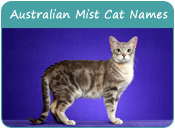
The Australian Mist was assembled from a precise formula. In 1977, Sydney geneticist Dr. Truda Straede began a breeding program with roughly 30 foundation cats: half Burmese, one quarter Abyssinian, one quarter spotted-tabby domestic shorthairs. Each parent line contributed something specific. The Burmese provided body type, temperament, and four solid base colors. The Abyssinian provided the ticked agouti gene that softens any tabby pattern overlaid on it. The domestic shorthairs provided the spotted pattern itself. The result reads as a lightly-frosted cat with spots or marble markings showing through agouti fog — the literal source of "Mist."
The breed went through two names. The Royal Agricultural Society of New South Wales Cat Club accepted "Spotted Mist" into its experimental category in May 1980, and the name held until June 1997, when the marbled pattern was added to the standard. "Australian Mist" then replaced "Spotted Mist" so the name covered both pattern types. This was the first breed wholly developed in Australia.
Recognition spread outward from Sydney. New Zealand granted Championship in 1999, the World Cat Federation in 2004, TICA on 1 May 2014, and GCCF in February 2017. The CFA and FIFe have not recognized the breed. The first UK imports arrived in February 2007, which is what eventually triggered the GCCF path.
Physically, the Australian Mist is medium-built, dense, glossy, and deceptively heavy for its size. Eyes are large and lustrous, in any shade of green. Standard colors are brown, blue, chocolate, lilac, cinnamon, fawn, and caramel. Straede deliberately selected for tolerance of children, dogs, and indoor living — a temperament that fits the Australian context where outdoor cat-keeping is restricted on wildlife grounds.
For names that honor the Australian origin directly, our Australian cat names hub covers geography, flora, and the country's distinct cat-naming culture in more depth.
Meanings, origins and pronunciations appear only for records with checked sources. Blank fields have not been verified. Gender and collection labels are browsing choices.
| Name | Meaning | Gender | Origin |
|---|---|---|---|
| Felix | Lucky or successful | Male | Latin |
| Finn | Male | Irish and Old Norse name histories | |
| Fluffy | Unisex | ||
| Foster | Male | ||
| Freckles | Unisex | ||
| Freo | Unisex | ||
| Gabby | Unisex | ||
| Galileo | Male | ||
| Garfield | Male | ||
| Gemma | Female | ||
| George | Farmer or worker of the land | Male | Greek-derived name |
| Georgia | Female | ||
| Gibbs | Unisex | ||
| Ginger | The ginger plant or spice; also a reddish-brown colour | Female | English word name |
| Gismo | Unisex | ||
| Gizmo | A gadget or device | Unisex | English word name |
| Gucci | Female | ||
| Gus | A short form of Augustus or Angus; also used for Konstantinos | Male | English and Greek expatriate usages |
| Gypsy | Female | ||
| Harlequin | Unisex | ||
| Harley | Female | ||
| Harry | Male | ||
| Higgins | Male | ||
| Hobo | Unisex | ||
| Hollie | Unisex | ||
| Holly | The holly tree | Female | English plant name |
| Holstein | Unisex | ||
| Honey | Honey produced by bees; also a term for a loved one | Female | English word name |
| Humdinger | Unisex | ||
| Hunter | Male | ||
| Isis | Female | ||
| Ivan | Male | ||
| Jack | A medieval familiar form of John | Male | English |
| Jackjack | Unisex | ||
| Jackson | Male | ||
| Jake | Male | ||
| Jasmin | Female | ||
| Jasmine | Female | ||
| Jasper | Associated with treasurer; also the gemstone word | Male | English name with an older Gaspar history |
| Jax | Male | ||
| Jedda | Male | ||
| Jemma | Female | ||
| Jess | Male | ||
| Jesse | Male | ||
| Jessie | Female | ||
| Jessy | Unisex | ||
| Jingles | Unisex | ||
| Joey | Male | ||
| Kat | Female | ||
| Kelly | Female |
336 names found. Page 3 of 7.
Related Naming Guides
Cat Names That Start With M: Milo, Mochi, Misty and More
Cat names that start with M range from compact calls such as Mae and Max to familiar favorites, food words, landscape references, strong sounds, traditional people names, fictional tributes and formal names with shorter daily forms. This collection treats the shared initial as a useful filter rather than a reason to mix unrelated candidates into one wall. Each entry explains its spoken shape, likely household association, nickname risk or pairing logic, while the surrounding sections compare nasal openings, vowel changes, syllable length and similar endings. The guide also shows how to preserve an M theme across several pets without creating Milo, Momo and Mocha confusion. Cultural references are labeled at the source level instead of being turned into personality claims. A final sound-grid method places each candidate beside family names, routine commands and the current pet roster, then tests the strongest three in ordinary care sentences. The resulting shortlist keeps the requested letter visible while allowing the cat’s age, behavior and daily environment to make the narrower decision.
Rainy Day Cat Names: Drizzle, Misty, Boots and Window-Watcher Picks
Rainy day cat names are about indoor weather: window glass, soft blankets, wet sidewalks, umbrella stands, steam, low light and the cat who decides that a storm is background music. This article keeps the topic distinct from the broader weather and storm guide by staying domestic rather than dramatic. Petrichor, the name for the smell after rain on dry ground, was coined in a 1964 Nature paper, and that single fact gives the article a useful scent-and-surface anchor. Names such as Rain, Misty, Storm, Blue, Ash, Sterling, Willow, River, Brook, Boots, Pepper, Sage, Pearl, Luna, Echo and Piper are resolved against the local name database when possible. Grey cats get mist, slate and silver names; black cats get wet-street names; orange cats get lamplight and tea names; white cats get pearl and cloud names. The piece includes pair ideas, sound checks and calm names for cats who hide during thunder.