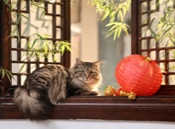
Chinese Mythology and Zodiac Cat Names: From the Great Race to Li Shou
By the iCatNames Editorial Team · Published
There is no Year of the Cat in the Chinese zodiac, and the reason is one of the oldest grudges in folklore. As the legend is most often told, the Jade Emperor announced a great race to choose the twelve animals that would mark the years. The cat and the rat were friends back then, and the cat — never an early riser — asked the rat to wake it on race day. The rat never did. In some versions it simply let the cat sleep; in others it rode across the river on the ox’s back and shoved the cat into the water as they neared the shore. Either way the cat arrived too late, the twelve spots were filled, and cats and rats have been enemies ever since. If you have ever watched your cat lock onto something small and scurrying, the story writes itself.
That legend is exactly why Chinese mythology is rich naming ground for a cat. This is not a generic Chinese baby-name list — it is a tour through zodiac lore, creator gods, moon goddesses, the demon-queller, and the meaning-dense words the culture wraps around fortune, jade, and the moon. A myth-rooted name carries a small story you can actually tell guests, and many of these words double as descriptions of coat, temperament, or the way a cat behaves. Below the names are grouped by where they come from in the mythology, with a pronunciation note near the end so you say Xi, Qi, and Cai the way they are meant to sound. Folklore is flagged as folklore; the deity roles are drawn from standard mythological sources.
The Great Race: zodiac animals that actually fit a cat
The cat lost its place in the cycle, but the twelve winners are still fair game — especially the ones whose qualities map onto feline behavior. Pick the animal whose nature your cat already performs.
- Tiger — the third zodiac sign, emblem of courage and a literal big cat; ideal for a bold, striped, or fearless housecat that thinks it runs the home.
- Dragon — the fifth and only mythical zodiac animal, sign of power and luck; suits a dramatic, attention-commanding cat with presence beyond its size.
- Hu (虎) — the Mandarin word for tiger, pronounced “hoo”; a compact, authentic pick for a tabby with a tiger’s glare.
- Long (龙) — “dragon,” said roughly “loong”; a short, strong call-name for a sinuous cat that stretches like a serpent.
- Ma (马) — “horse,” the seventh sign, tied to freedom and speed; fitting for a cat that gallops the hallway at 3 a.m.
- Shu (鼠) — “rat,” the trickster winner; a tongue-in-cheek name for a clever, food-stealing cat that would absolutely have cheated the race.
- Niu (牛) — “ox,” the patient animal that carried the rat across the river; right for a placid, sturdy, unbothered cat.
Note for trivia lovers: the Vietnamese zodiac swaps the rabbit for the cat, so in Vietnam the cat does get a year. That is a real difference between the two systems, but the names here stay rooted in the Chinese telling.
Li Shou and the cat who was once a god
One strand of Chinese folk belief gives the cat a far grander past. In a widely retold creation story, when the world was new the gods appointed a creature to oversee it and chose the cat, granting it the power of speech to relay divine instructions. The cat goddess Li Shou (李首) was named to lead them. The cats, however, preferred dozing in sunbeams to running the world, and after one nap too many the gods handed the job to humans — which the story says is why cats sleep so much and answer to no one. Li Shou also appears in folk practice as a deity farmers honored to keep rats from the crops. Treat this as folk belief rather than a fixed scripture; sourcing is popular and folkloric, and the famous “Book of Rites” connection is repeated widely but should be taken loosely.
- Li Shou — the cat goddess herself, said “lee show”; the most on-the-nose mythic name there is for a cat, and unbeatable as a story to tell.
- Mao (猫) — simply “cat,” pronounced “mao” like the sound; a self-aware, minimalist name that already exists in the dictionary as Mao.
- Shou — pulled from Li Shou, an easy two-letter call-name that nods to the deity without the full title.
Gods and immortals: names from the Chinese pantheon
The high gods of Chinese myth carry real gravitas of their own. Match the deity’s role to your cat’s personality and the name does double duty.
- Nuwa (女娲) — the creator goddess who molded the first humans from clay and patched a hole in the sky; a maternal, founding-figure name for a queen-bee cat or a watchful mother.
- Chang’e (嫦娥) — the goddess who drank the elixir of immortality and rose to live on the moon; graceful and aloof, right for a distant, elegant cat that keeps its own hours.
- Guanyin (观音) — goddess of mercy and compassion who hears those in need; gentle and fitting for a calm, comforting lap cat.
- Wukong — from Sun Wukong, the Monkey King, born from stone and able to shapeshift into seventy-two forms; built for a mischievous, acrobatic, escape-artist cat.
- Yuhuang — the Jade Emperor (Yu Huang), ruler of Heaven who oversaw the very race that excluded the cat; a grand, slightly ironic title for a cat that clearly considers itself the boss.
- Xiwangmu — the Queen Mother of the West, ancient guardian of the peaches of immortality; a regal, weighty name for a dignified senior cat.
- Zhongkui — Zhong Kui, the fierce demon-queller who hunts evil spirits; a protective, no-nonsense name for a tomcat that patrols the house at night.
- Hou Yi — the archer who shot down nine suns and was left behind when Chang’e ascended; a strong companion name, especially paired with a Chang’e.
Chang’e’s moon and the celestial sky
The moon goddess does not live alone — her companion is the Jade Rabbit, who pounds the elixir of immortality with a mortar and pestle. That whole lunar scene is a soft, dreamy source for a quiet cat, and the broader night sky fills out the theme.
- Yue (月) — “moon,” the realm Chang’e rules; verified in the dictionary as Yue, a clean one-syllable name for a pale or nocturnal cat.
- Moon — the plain-English equivalent for a round-faced, white, or night-loving cat that glows in the dark hallway.
- Yutu — the Jade Rabbit (Yu Tu) who grinds the immortality elixir on the moon; a pull for a busy, paw-working cat that never sits still.
- Xing (星) — “star,” said “shing”; suits a cat with a white star-mark on its chest. English speakers can use Star.
- Yun (云) — “cloud,” said “yoon”; soft and drifting, right for a grey or fluffy cat. The dictionary has Cloud for the English version.
- Comet — for a blur of a cat that crosses a room before you register it moved.
- Sky — open and celestial, a fit for a calm grey-blue coat.
Auspicious words: fortune, joy, and virtue
Chinese naming leans hard on lucky and virtuous words — the same characters you see on red New Year banners. These are the cat-name equivalent of bringing good fortune through the door.
- Fu (福) — “fortune, blessing,” the single most common luck word in China, hung upside-down on doors at New Year; verified as Fu, a pocket-sized powerhouse of a name.
- Xi (喜) — “joy”; doubled as Shuangxi (double happiness) at weddings, said “shee.” A bright name for a cheerful, purr-prone cat.
- Cai (财) — “wealth,” said “tsai”; the word in the New Year greeting for prosperity, fitting for a cat that arrived and made itself rich on your couch.
- An (安) — “peace, calm,” said “ahn”; the right note for a serene, even-tempered cat.
- Ming (明) — “bright, clear”; verified as Ming, a crisp name for an alert, sharp-eyed cat.
- Lucky — the direct English wish, earned by any cat that turned up at the right door.
- Feng (凤) — the phoenix, paired with the dragon as a symbol of grace and rebirth; use Phoenix in English for a fiery, resilient cat.
Jade, gold, and treasure
Jade is the most prized stone in Chinese culture — a symbol of purity, virtue, and protection — and treasure words carry the same affection you already feel for the cat. These suit luminous coats and cherished pets.
- Jade — the green stone valued above gold in China, emblem of virtue and luck; ideal for a jade-eyed cat, or any treasured one.
- Yu (玉) — the Mandarin word for jade itself; verified as Yu, the authentic one-syllable form behind the English name.
- Jin (金) — “gold,” said “jeen”; an obvious pick for a ginger, copper, or golden-eyed cat.
- Bao (宝) — “treasure, precious one,” the affectionate word a parent calls a child; warm for the cat you spoil most.
- Treasure — the plain-English version for exactly the same sentiment.
- Pearl — tied to dragon lore, where the dragon chases a flaming pearl; right for a small white or cream cat.
- Amber — the warm fossil-resin gem, a fit for a honey-eyed or golden-brown cat.
Nature, flowers, and the four seasons
Classical Chinese poetry and painting return again and again to a handful of plants and blossoms, each loaded with meaning — the plum that blooms in snow, the bamboo that bends but does not break, the lotus that rises clean from the mud.
- Mei (梅) — the plum blossom, first flower of late winter, symbol of resilience; said “may.” English speakers can use Plum or Blossom.
- Lian (莲) — the lotus, emblem of purity that rises clean from the mud; said “lyen.” Lotus is the verified English form.
- Zhu (竹) — bamboo, sign of integrity and flexibility; said “joo.” Use Bamboo in English for a slim, supple, springy cat.
- Hua (花) — simply “flower,” said “hwah”; a gentle catch-all for a pretty, delicate cat.
- Peony — the “king of flowers” and a Chinese symbol of wealth and honor; lush and fitting for a fluffy, opulent cat.
- Willow — the graceful tree of Chinese gardens and poetry; suits a slender, supple cat.
- Cherry — for the spring blossom and a pink-nosed, sweet-faced cat.
Names by coat color
Chinese color words are short and concrete, which makes them excellent call-names. Match the character to the coat and the name explains itself.
- Hei (黑) — “black,” said “hay”; the plain word for a glossy black cat. English options in the dictionary include Ink, Shadow, Onyx, and Midnight.
- Mo (墨) — “ink,” the black ink of calligraphy; poetic for a glossy black coat, with Ink as the ready English form.
- Bai (白) — “white,” said “buy”; for a pure white cat. The dictionary offers Snow and Snowball.
- Xue (雪) — “snow,” said “shweh”; the more lyrical white-cat word behind Snow.
- Jin (金) — “gold,” doing color duty for a ginger or honey-gold cat; pair with English Goldie or Ginger.
- Sable — deep brown-black, a fit for a dark seal-point or rich brown coat.
- Smoke — for the silvery grey of a smoke-coated cat, echoing Yun, the cloud.
Edible nods: lucky food names
Food carries luck in Chinese culture too, and these double as cozy call-names that happen to be in the dictionary.
- Mochi — the soft, round rice cake; right for a squishy, round-bodied cat.
- Peach — the fruit of immortality guarded by Xiwangmu in her heavenly garden; a mythic-and-sweet pick.
- Mango, Tofu, Dumpling, Noodle — warm, food-loving names for an unfussy, snack-motivated cat.
- Ginger — both a kitchen staple and the obvious color word for an orange cat.
Pairs and trios: two cats from one legend
Mythology hands you ready-made pairings — characters who belong in the same story, so two cats carry one shared theme.
- Chang’e and Hou Yi — the moon goddess and the archer she left behind; a bonded pair where one is aloof and one is devoted.
- Chang’e and Yutu — the moon goddess and her Jade Rabbit companion; a calm cat and a busy little sidekick.
- Yue and Star (Yue and Xing) — moon and star, a matched celestial set for two cats that nap together.
- Dragon and Phoenix (Long and Feng) — the classic dragon-and-phoenix pairing of power and grace; the definitive duo for a bonded pair, male and female.
- Fu and Lucky — fortune in two languages, a cheerful pair of good-omen cats.
- Ink and Snow (Mo and Xue) — black and white, the simplest and sharpest matched set for two opposite coats.
How to say them: a quick pinyin note
Pinyin spells some sounds in ways that surprise English readers, so a few rules go a long way. X is a soft “sh,” so Xi is “shee” and Xing is “shing.” Q is a soft “ch,” so Qi is “chee.” Zh is like the “j” in jump, so Zhu is “joo” and Zhongkui starts “jong.” C is “ts,” so Cai is “tsai” (rhymes with “sky”). E on its own is closer to “uh.” Mandarin is tonal, but a cat does not need the tones to learn its name — a consistent one- or two-syllable sound is what matters, which is why short picks like Yue, Fu, Mao, and Jin work so well at the food bowl.
The cat may have been cheated out of its year, and Li Shou may have napped through her divine appointment, but Chinese mythology arguably owes cats a debt — and a good name pays a little of it back. Whether you reach for a god’s gravitas with Guanyin or Wukong, a luck word like Fu or Cai, a moon name like Yue, or just the honest Mao, you are handing your cat a name with a story underneath it. Try each aloud a couple of times, see which one turns the ears, and let the legend settle in around the animal that, by rights, should have had a year of its own.