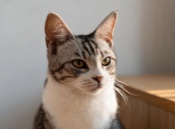
Ukrainian Levkoy Cat Names: Naming the Hairless Cat With Folded Ears and an Angular Face
By the iCatNames Editorial Team · Published
Picture a cat with no coat to speak of, skin that gathers into soft wrinkles across the brow, and ears that fold inward toward the skull rather than standing up. Now give that cat a long, angular head — a stepped profile that breeders and owners alike describe as “dog-like” — and you have the Ukrainian Levkoy, the only cat in the world that combines hairlessness with folded ears in a single silhouette. It is a deliberate, modern creation, and everything about its look points back to two parent breeds and one unlikely flower.
That flower is where the name begins. The levkoy is the garden stock, a fragrant bloom whose bent leaf reminded the breed’s creator of the cat’s downturned ears. Naming a Levkoy well means honoring all of this at once: the bald, sculptural body, the elfin ears, the Kyiv origin, the warmth a hairless cat is always chasing, and the botanical hook hiding in the breed’s own name. The sections below build six distinct name themes from those traits, plus pairing ideas and a frank comparison with the breeds it is most often confused for.
Where the Ukrainian Levkoy comes from
The breed was developed in Kyiv, Ukraine, by felinologist Elena (Olena) Biriukova, who began the program around 2000 and reached the established look by 2004. The first registered Ukrainian Levkoy, recorded by the ICFA RUI breeding commission, was born on January 21, 2004. Biriukova’s method was a cross: hairless Donskoy females bred to Scottish Fold males, with Oriental and non-pedigree cats added later to broaden the gene pool. From the Donskoy came the bald skin and wrinkles; from the Scottish Fold came the folded ears. No earlier cat had carried both traits together.
On recognition, it pays to be honest. The Ukrainian Levkoy is acknowledged mainly by Ukrainian and Russian felinological systems — ICFA RUI recognized it as a breed around 2005 — and it is not held to championship status by TICA, CFA, or FIFe. It remains an Eastern European rarity rather than a globally established show breed. A name that nods to Kyiv, then, is not a marketing gesture; it marks where this cat genuinely came from.
The name from a flower
The levkoy is the common stock, botanically Matthiola (the garden species is Matthiola incana), a clove-scented cottage-garden flower also called gillyflower. The breed was named for it because the cat’s ears, bending forward and down, echo the folded leaf of the stock plant. It is a quiet, specific etymology — not a grand legend, just a breeder noticing that an ear looked like a leaf — and it makes the flower-and-garden name theme below feel earned rather than decorative.
This botanical thread runs deeper than a single bloom. The stock belongs to the same broad family as wallflowers and other fragrant spring flowers, so a Levkoy can carry a garden name and still sit squarely inside the breed’s own story. Few cat breeds are named after a flower at all; fewer still let you reach straight back to the namesake when you name the animal.
Two parent breeds, two signature traits
Hairlessness in the Levkoy traces back to the Donskoy, and the genetics matter here. The Donskoy carries a dominant baldness gene, which is a real contrast with the Sphynx, whose hairlessness comes from a recessive variant in the KRT71 gene. That difference is not trivia: a dominant trait passes more readily from a single hairless parent, which is part of why the Donskoy could seed a new bald breed so directly. The result is skin that ranges from fully bald to lightly “flocked” with fine down, often wrinkled around the head and shoulders.
The folded ears come from the Scottish Fold, and this is where care and conscience meet. The fold is caused by a variant in the TRPV4 gene that affects cartilage development — and the same gene is linked to osteochondrodysplasia, a painful bone-and-cartilage disorder that can affect cats carrying even one copy of the variant. Veterinary and welfare bodies have raised serious, well-documented concerns about breeding for folded ears for this reason. A prospective Levkoy owner should go in informed, ask a breeder directly about the lineage and health of the fold trait, and watch for stiffness, lameness, or thickened tails and limbs. None of that diminishes the individual cat you bring home; it simply means choosing a name should sit alongside choosing a responsible breeder and a good vet.
Levkoy vs Donskoy vs Scottish Fold vs Peterbald vs Sphynx
The Levkoy is easy to confuse with four other breeds, but the combination it carries is unique. This table lines them up on the traits that actually distinguish them.
| Breed | Ears | Coat | Hairless gene | Origin |
|---|---|---|---|---|
| Ukrainian Levkoy | Folded inward | Bald to lightly flocked | Dominant (from Donskoy) | Kyiv, Ukraine, ~2004 |
| Donskoy | Straight, upright | Bald to flocked/brush | Dominant | Rostov-on-Don, Russia |
| Scottish Fold | Folded inward | Full coat (furry) | None (haired breed) | Scotland |
| Peterbald | Straight, large | Bald to flock/brush | Dominant (Donskoy-derived) | St. Petersburg, Russia |
| Sphynx | Straight, very large | Bald with fine down | Recessive (KRT71) | Canada |
Read across and the Levkoy’s identity snaps into focus: it is the one row that is both hairless and folded-eared. The Donskoy and Peterbald are bald with straight ears; the Scottish Fold is folded but furry; the Sphynx is bald via a different, recessive route. The Levkoy borrows from two of them and matches none.
Temperament and care
Levkoys are intensely people-oriented. They attach hard to their humans, follow them room to room, involve themselves in whatever the household is doing, and tend to dislike long stretches alone — a sociability that, with the angular face, feeds the dog-like reputation. They are intelligent and playful, sometimes reserved with strangers, and they want company more than they want independence.
Care follows from the hairless skin. With no coat to absorb oils, the skin needs gentle, regular bathing, and these cats actively seek warmth — a sunny windowsill, a lap, a blanket, a heated bed. They feel cold and sunburn more readily than coated cats, so indoor warmth and shade matter. The folded ears need careful, regular cleaning because wax builds up where the ear bends. A name can quietly reflect this side of the cat too, which is why a whole theme below leans into sunshine and warmth.
Ukrainian and Kyiv heritage names
This breed is Ukrainian to its core, born in Kyiv, and the cleanest way to honor that is with Ukrainian given names, the capital’s landmarks, the Dnipro river, and the sunflower that stands as Ukraine’s national flower. These names place the cat where it actually came from.
- Kyiv — the capital where the breed was created, worn straight as a name.
- Sunflower — Ukraine’s national flower, gold-headed and proud.
- Dnipro — the great river that runs through Kyiv, written plainly.
- Oksana — a popular Ukrainian given name with old Slavic roots (no English-dictionary entry, so worn as-is).
- Mila — short, warm, and common across Ukraine, from a root meaning dear.
- Bohdan — a strong Ukrainian name meaning “given by God,” suited to a bold tom.
- Lev — meaning lion, a Ukrainian classic that also nods to the breed’s own “Lev-” opening.
- Solomiya — a graceful Ukrainian name carried by the famed singer Solomiya Krushelnytska.
- Ivan — the enduring Ukrainian form of John, plain and grounded.
- Kalyna — the guelder rose, a deep Ukrainian folk symbol of home and resilience.
- Vera — meaning faith, soft on the tongue and at home in Slavic households.
- Taras — after Taras Shevchenko, Ukraine’s national poet, for a dignified cat.
Flower and stock-garden names
Since the breed is literally named for the levkoy flower — the garden stock — a botanical name closes the loop back to where the breed’s name began. These reach into the cottage garden the stock belongs to, all blooms and petals and scent.
- Stock — the English name of the levkoy flower itself, the most direct nod there is.
- Gilly — from gillyflower, the old name for the fragrant stock (gloss kept outside; worn as a pet form).
- Petal — small, soft, and apt for a flower-named breed.
- Blossom — full bloom in a single word, gentle and bright.
- Iris — another garden bloom, crisp and elegant on a sleek cat.
- Violet — cottage-garden color and flower in one name.
- Poppy — cheerful and round-sounding, easy to call down a hallway.
- Clover — low, lucky, and green, a meadow name for a garden breed.
- Marigold — warm gold, fitting for a heat-loving hairless cat.
- Lily — clean and classic, a flower name that never tires.
- Jasmine — scented and delicate, echoing the stock’s own fragrance.
- Fleur — simply “flower” in French, for an elegant nameplate.
Folded-ear and elfin names
Those inward-folding ears are the trait that gave the breed its name, and they give the cat a slightly fey, storybook look. These names lean into the elf-and-pixie register, the small folkloric creatures with pointed or curled ears.
- Elf — the obvious, irresistible nod to those folded, fairy-tale ears.
- Pixie — small, mischievous, and pointed, a perfect ear-led name.
- Sprite — a flickering woodland spirit, light and quick.
- Puck — the trickster sprite of folklore and Shakespeare, for a playful cat.
- Gnome — small and earthy, with a wink at the storybook silhouette.
- Fae — the fairy realm in a single soft syllable.
- Wisp — faint and elfin, suited to a slight, fine-skinned cat.
- Pip — tiny and bright, an elfin name that calls easily.
- Nimue — the water-enchantress of Arthurian legend, for a mysterious, fey-eared female.
- Robin — as in Robin Goodfellow, another name for Puck the sprite.
- Twig — small and woodland, echoing the bent-leaf ear shape.
- Fawn — gentle and folkloric, soft as the down on flocked skin.
Sculptural and angular names
Strip away the fur and the Levkoy becomes a study in line and plane: the long wedge head, the stepped profile, the bare contours of muscle and bone. These names treat the cat as sculpture — stone, metal, and carved material that suit a body you can read like a form.
- Marble — cool, smooth stone for a sleek, sculptural body.
- Onyx — deep polished black, for a dark-skinned Levkoy.
- Slate — flat gray stone, spare and architectural.
- Granite — hard, grounded, and statuesque, for a solid tom.
- Pewter — muted metallic gray, matte like bare skin.
- Bronze — warm cast metal, fitting for a tawny hide.
- Chisel — the tool that carves, for that angular wedge of a head.
- Flint — sharp gray stone, lean and edged.
- Clay — the material a sculptor shapes, soft then set.
- Ash — pale, fine gray, for lightly flocked skin.
- Quartz — crystalline and angular, catching the light.
- Cameo — a carved profile in relief, for that stepped dog-like face.
Warm-skin and sunshine names
A hairless cat is forever chasing heat — the sunbeam, the radiator, the warm lap — and that habit is so central to living with a Levkoy that it deserves its own set of names. These are sun, fire, and warmth words for a cat that gravitates to anywhere cozy.
- Sol — the sun itself, short and golden.
- Sunny — bright and warm, an easy call for a heat-seeker.
- Ember — a glowing coal, soft heat that lingers.
- Blaze — open flame, for a lively, warmth-loving cat.
- Phoenix — the firebird reborn from heat, dramatic and apt.
- Cinder — the warm remains of a fire, gray and glowing.
- Sahara — sun-baked desert, all heat and bare skin.
- Amber — warm golden resin, the color of a sunbeam.
- Hearth — the warm centre of a house, where a Levkoy gravitates to settle.
- Cozy — plain and affectionate, for a cat that hunts comfort.
- Sunny is paired naturally with Beam — a strip of sunlight, the spot this cat will claim.
- Toasty — lightly playful, for a lap-loving warmth addict.
Slavic strength and folklore names
To keep this distinct from generic Russian naming, these lean Ukrainian and Slavic — folklore figures, old strong names, and mythic words from the cultural soil the breed grew in. They suit a cat with a bold, sculptural presence.
- Mavka — a forest nymph of Ukrainian folklore, beautiful and wild (worn as-is).
- Perun — the Slavic thunder god, for a commanding tom (no English entry; plain).
- Zorya — the Slavic dawn star, a guardian spirit of morning light.
- Dazhboh — a Slavic sun deity, fitting doubly for a heat-loving cat (plain).
- Veles — the old Slavic god of earth and cattle, earthy and strong (plain).
- Rusalka — a water spirit of Slavic legend, mysterious and lithe.
- Lada — a Slavic goddess associated with love and spring (plain, worn as a name).
- Vladimir — “ruler of peace,” a weighty old Slavic name.
- Svetlana — from a root meaning light, bright and strong (plain).
- Boris — short for a name meaning battle, blunt and bold.
- Yaroslav — after Yaroslav the Wise of Kyiv, for a regal cat (plain).
- Mara — a Slavic spirit of winter and night, for a sleek dark female.
Names for two Levkoys
Two hairless, folded-eared cats invite paired names that play on the breed’s own threads — the flower, the origin, the warmth, the sculpture. These keep the duo legibly linked without matching too cutely.
- Stock & Gilly — two names for the same namesake flower, a botanical pair.
- Sol & Luna — day-star and night-star, for two warmth-seekers split between window and lamp.
- Kyiv & Dnipro — the city and its river, an origin pairing.
- Elf & Pixie — two folded-ear sprites, well matched.
- Marble & Onyx — pale stone and dark, a sculptural light-and-shadow set.
- Ember & Ash — the glow and what it leaves, warm and quiet together.
- Mavka & Rusalka — two Slavic folk spirits, forest and water.
- Petal & Blossom — a gentle garden pair for two flower-named cats.
Choosing the right name
The strongest Levkoy names come from the breed itself rather than from any generic cat-name list. This is a cat with a real birthplace, a flower hiding in its name, a bald and sculptural body, ears that fold like a leaf, and a constant pull toward warmth — any one of those is a richer starting point than a name picked at random. Live with the cat for a week, watch where it sleeps and how it moves, and let the angular face or the sun-chasing habit suggest the word. Say your shortlist aloud at feeding time; the name that fits will be the one the cat seems to come to, and the one that still feels right a year from now.