Cheetoh Cat Names: Naming the Spotted Giant With a Domestic Heart
By the iCatNames Editorial Team · Published
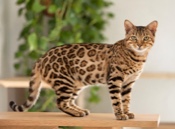
Few cats carry a face this fierce over a heart this soft. The Cheetoh looks like a small leopard crossed your living room floor — rosetted, muscular, low to the ground, moving with a stalking glide that belongs in tall grass. Then it climbs into your lap and falls asleep. That contradiction is the entire point of this breed, and it explains why naming a Cheetoh is its own small puzzle: the name has to live up to the wild costume without lying about the gentle animal wearing it.
What makes the Cheetoh genuinely unusual among spotted cats is its recipe. It is a second-generation designer cat, built not from a wild species but from two breeds that already looked wild on their own — the Bengal and the Ocicat. Most exotic-looking cats reach for the jungle by adding a wild ancestor. The Cheetoh reaches the same place by combining two domestic spotted breeds and concentrating their best traits. The outcome is a cat that earns the leopard comparison honestly while keeping a temperament that breeders consistently describe as patient and unflappable. The name you choose can lean into either side — the predator look or the lap-cat heart — and the most satisfying names hold both at once.
Where the Cheetoh comes from
The Cheetoh traces to American breeder Carol Drymon of Wind Haven Ranch, who conceived the cross around 2001. Her idea was deliberate: take the Bengal, with its rosetted coat and athletic build, and the Ocicat, with its agouti ticking and that distinctive low-shouldered walk, and breed them together to produce a cat that looked even more like a jungle cat than either parent — without introducing any fresh wild blood into the cross itself. The first litters arrived around 2003.
The breeding program drew early backing from smaller registries before larger ones took notice. By some accounts the United Feline Organization accepted the Cheetoh in November 2004, and TICA later listed it as an experimental, developing breed (the year 2011 is frequently cited for that registry status). “Experimental” in registry language means the breed can be registered and tracked but is not yet eligible for championship competition. That status, combined with a small pool of dedicated breeders, is exactly why the Cheetoh remains genuinely rare today — far rarer than either of its parent breeds.
It helps to be precise about that parentage. The Ocicat itself is an entirely domestic breed, developed from Abyssinian, Siamese, and American Shorthair lines in the 1960s by Virginia Daly; it was bred to mimic a wild ocelot but carries no recent wild ancestry. The Bengal is the breed that supplies the genuine wild thread, and we will be honest about that in the next section. Carol Drymon’s contribution was to fuse these two spotted lineages into a single larger, more leopard-like animal whose disposition stayed firmly domestic.
Why it looks wild but acts tame
Here is the honest version of the wild-ancestry question, because it gets oversimplified in both directions. It is not true that the Cheetoh has “no wild blood ever” — its Bengal parent descends from crosses between domestic cats and the Asian leopard cat. But that ancestry is distant. To be registered as a domestic Bengal, a cat must sit at least four generations removed from the wild leopard cat, and genetic studies suggest only a few percent of a typical Bengal’s genome traces back to that wild ancestor on average. The Ocicat side contributes none at all. So the accurate framing is this: the Cheetoh is two domestic spotted breeds combined, one of which carries faint, generations-old wild ancestry — not a recent wild hybrid.
That distinction matters because of what it produces. The spotted and rosetted coat, the warm sienna-to-golden ground colors, the agouti ticking that makes the fur shimmer — these are coat-pattern genetics that the breeds carry as domestic traits, not behavior genes. The temperament comes from selecting calm, social, child-tolerant animals across generations. So the Cheetoh delivers the visual payoff of wildness while behaving like the steady housecats it actually descends from. The coat is short, thick, and plush, and the cat is built large and muscular — males are often reported in the 15-to-23-pound range, with females noticeably smaller, frequently cited up to around 15 pounds.
The signature movement is worth naming on its own. Because the hind legs run slightly longer than the forelegs, the Cheetoh walks with a low, shoulder-rolling, stalking gait — the same loping prowl seen in the Ocicat and in wild cats, and rarely in ordinary housecats. Watching a Cheetoh cross a room is a large part of why the breed earns its reputation, and it is fertile ground for a name.
Cheetoh vs. the other spotted breeds
The Cheetoh is easy to confuse with several look-alike breeds. The table below sorts out the real differences — especially the all-important question of which breeds actually carry recent wild ancestry and which only imitate it.
| Breed | Foundation cross | Recent wild blood? | Coat | Size | Temperament |
|---|---|---|---|---|---|
| Cheetoh | Bengal × Ocicat | None added in the cross; faint Bengal-side ancestry several generations back | Rosetted/spotted ticked tabby, golden to sienna | Large; males often 15–23 lb | Gentle, social, notably patient |
| Bengal | Domestic × Asian leopard cat | Yes — but registered domestics are 4+ generations removed | Rosettes or marbling, glittered | Medium; ~8–15 lb | High-energy, busy, clever |
| Ocicat | Abyssinian × Siamese × American Shorthair | None — fully domestic | Ticked spotted tabby | Medium to large | Outgoing, dog-like, vocal |
| Savannah | Domestic × serval | Yes — a true wild hybrid | Bold dark spots on tawny | Often very large, tall, long-legged | Athletic, intense, demanding |
| Serengeti | Bengal × Oriental Shorthair | No serval; only the distant Bengal thread | Spotted, long-legged, large-eared | Medium, leggy | Active, very vocal |
One more easy mix-up: the Toyger is also a Bengal-derived breed, but it is bred for vertical tiger-like stripes rather than spots, so it sits in a different visual category entirely. The Cheetoh’s lane is unmistakable — a big, spotted, gentle cat with a prowling walk.
Temperament & care
For all the leopard theatrics, the Cheetoh’s defining trait is its even temper. Breeders describe a cat that is social rather than aloof, tolerant of handling, and steady enough around children that many recommend it for busy households. It tends to bond closely, follows people from room to room, and keeps the Bengal’s intelligence without always running at the Bengal’s frantic energy level.
That said, this is still an athletic, large, agile animal. A Cheetoh wants climbing height, puzzle toys, and real interaction; a bored Cheetoh will invent its own entertainment. The short, plush coat is low-maintenance and not a heavy shedder, so grooming is light. Plan instead for vertical space, sturdy scratching surfaces, and play that lets the stalking instinct fire harmlessly at a wand toy. Name-wise, all of this gives you two honest directions to pull from — the wild silhouette and the affectionate, people-loving core — and the six themes below are built to serve both.
Big cats & wild spotted felines
These names borrow directly from the spotted and rosetted wild cats the Cheetoh was bred to evoke — the look first, the heart second.
- Cheetah — the obvious spotted sprinter the breed’s very name nods to.
- Leopard — the rosetted cat whose coat the Cheetoh most resembles.
- Ocelot — the small dappled wild cat that inspired the Ocicat parent line.
- Jaguar — for a heavier, broad-headed Cheetoh with bold rosettes.
- Panther — the prowling big-cat archetype, for a darker-marked cat.
- Lynx — a fitting tag for the lynx-pointed snow color variants.
- Serval — the leggy African cat behind the Cheetoh’s look-alike, the Savannah.
- Cougar — understated power for a big, muscular male.
- Bengal — a wink to one of the two breeds that built the Cheetoh.
- Margay — the tree-climbing spotted cat, for an agile, vertical lap.
- Tiger — classic feline grandeur, even on a spotted coat.
- Lion — for the cat who rules the household with calm authority.
Spotted-coat & marking names
The rosettes and ticked spots are the Cheetoh’s signature, so these names celebrate the pattern itself rather than any wild stand-in.
- Spot — plain, affectionate, and exactly right for a spotted cat.
- Domino — for crisp dark spots scattered on a pale ground.
- Freckles — warm and unfussy, for a finely speckled coat.
- Dapple — the soft scatter of light-and-dark across the fur.
- Rosette — the breed’s defining marking, used straight as a name.
- Patch — honest and homely for a cat with bold blotches.
- Pixel — modern wit for a coat that reads like scattered points.
- Speckle — fine flecking, said affectionately.
- Inkblot — playful, for irregular dark markings.
- Dot — minimalist and sweet for a small spotted female.
- Tickle — a soft pun on the agouti “ticked” coat.
- Marble — for a Cheetoh whose rosettes swirl toward a marbled look.
Golden, amber & sandy coat colors
The Cheetoh’s ground color runs warm — sienna, tawny, golden, sorrel — and these names pull straight from that palette.
- Amber — the fossil-resin glow of a rich golden coat.
- Honey — soft and sweet for a pale tawny cat.
- Sienna — named for the very pigment breeders use to describe the coat.
- Goldie — uncomplicated warmth for a golden-spotted cat.
- Saffron — the deep orange-gold spice, for a vivid ground color.
- Caramel — a buttery mid-tone for a softly golden Cheetoh.
- Sandy — the pale desert color of a light sienna coat.
- Marigold — bright botanical gold for a sunny-toned cat.
- Topaz — the golden gemstone, matching warm eyes and coat.
- Copper — a metallic red-gold for a mahogany-tinged Cheetoh.
- Sorrel — one of the breed’s own listed color variations.
- Sunny — cheerful and plain, for the warmest golden coats.
Speed, athleticism & the stalking gait
That low, loping, shoulder-rolling walk is half the Cheetoh’s charisma, so these names honor movement, power, and the hunt.
- Dash — for the burst of speed at the end of a stalk.
- Bolt — quick and electric for a fast, athletic cat.
- Stalker — literal credit for the signature prowling walk.
- Hunter — the instinct behind that low, deliberate gait.
- Flash — for the cat that vanishes between rooms.
- Swift — spare and accurate for a nimble Cheetoh.
- Prowler — the quiet, watchful movement, named plainly.
- Sprint — the short explosive run of a spotted predator.
- Jet — sleek velocity for a powerful male.
- Nimbus — for a cat that drifts across the room on silent air.
- Racer — cheerful nod to the breed’s athletic build.
- Comet — a streak of motion across the floor.
African savanna & safari names
The wild look invites a tasteful safari nod — landscapes, rivers, and places that evoke open grassland without pretending the cat is anything but domestic.
- Sahara — the great African desert, for a sandy-gold coat.
- Savanna — the grassland habitat the look gestures toward.
- Kenya — an East African place-name with warmth and weight.
- Zulu — a strong, rhythmic name with southern-African roots.
- Nile — the long African river, for a sleek, flowing cat.
- Sahel — the dry grassland belt, an apt name for a tawny coat.
- Jambo — a Swahili greeting, friendly and easy to call.
- Acacia — the iconic savanna tree, soft and botanical.
- Zambezi — the great river, for a large, commanding cat.
- Sahel — the parched borderland, fitting for sandy ground color.
- Oasis — a calm green refuge, for a gentle desert-colored cat.
- Mara — for the Masai Mara grassland, short and call-friendly.
Gentle-giant & big-softie names
This is the truest theme for the breed: a large, fierce-looking cat with an affectionate, patient heart. These names honor the contrast.
- Teddy — the soft-toy name for a leopard-faced lap cat.
- Biggie — affectionate size with no menace at all.
- Cuddles — the plush coat and the lap-seeking heart, named outright.
- Marshmallow — soft and sweet under the wild costume.
- Gentle — used straight, for the breed’s defining trait.
- Tank — big and solid, but a softie underneath.
- Buddy — the people-loving, follow-you-around side of the cat.
- Snuggles — for the Cheetoh that turns every chair into a pile.
- Moose — comic size for a muscular but mellow male.
- Bear — big, warm, and slow to anger.
- Pillow — the plush, restful side of a fierce-looking cat.
- Gentry — quiet dignity for a large, well-mannered Cheetoh.
Names for two Cheetohs
If you bring home a pair, let the names echo one of the themes above — the look on one side, the heart on the other, or two halves of the same idea.
- Spot & Dot — two takes on the marking, scaled large and small.
- Amber & Topaz — two warm golden gemstones for a matched pair.
- Dash & Bolt — twin bursts of the stalking sprint.
- Sahara & Nile — desert and river, a savanna pairing.
- Leopard & Lynx — two spotted wild cats for the look.
- Teddy & Bear — the gentle-giant joke, doubled.
- Honey & Saffron — pale and deep on the same golden palette.
- Hunter & Prowler — two names for the same patient walk.
Choosing the right name
The trap with a cat this dramatic is to over-reach for the wild and end up with a name that fits a poster more than a pet. The Cheetoh rewards a lighter touch. Sit with the actual animal for a few days before deciding: watch how it moves, where the spots cluster, whether it leads with the predator prowl or the lap-cat lean. A name like Stalker or Leopard celebrates the silhouette; a name like Teddy or Honey tells the truth about who greets you at the door. The most fitting Cheetoh names usually hold a little of both — a wild word said with affection, or a soft word given to a cat who could pass for a small leopard. Whatever you land on, let it be something you can call across the house a hundred times a day without tiring of it, because this is a cat that will follow the sound of it straight to your feet.