Mekong Bobtail Cat Names: River, Royal-Siamese & Colorpoint Names
By the iCatNames Editorial Team · Published
Most short-tailed cats are curiosities. The Mekong Bobtail is something rarer: a survivor. When you look at one of these slim, pointed, sapphire-eyed cats, you are looking at roughly the same animal that prowled the temples and royal courts of old Siam — the cats that the modern Western Siamese descended from, but with one crucial difference. Western breeders spent a century straightening the kink out of the Siamese tail to suit show standards. Along the Mekong River, nobody bothered. The kinked tail was considered lucky, even sacred, and so it endured. The Mekong Bobtail you might name today still carries it.
That makes naming this cat a different exercise than naming a designer breed. You are not decorating a pet; you are honoring a lineage that runs through palaces, monsoon rivers and a tail so individual that no two are ever the same. This guide grounds the breed facts first, then gives you themed names — river and Southeast Asia, royal-Siamese heritage, colorpoint and blue eyes, the famous tail, temple serenity, and jewels — with a gloss on each so you know exactly what you are choosing.
A living link to the original royal cats of the Mekong
The story usually told is that in the late 19th century, King Chulalongkorn of Siam gifted a large number of royal cats to the Russian Tsar Nicholas II, and that the majority of those cats carried the short kinked tail we now associate with the Mekong Bobtail. In their homeland these were palace and temple cats, kept by royalty and believed to guard sacred spaces. Sources treat the Tsar anecdote as breed lore more than documented pedigree, so hold it lightly — but the broader point is solid: the pointed, kink-tailed cat of Southeast Asia is the older form, and the long-tailed Western Siamese is the bred-out descendant.
What the West discarded, the East preserved. The bobbed tail was eliminated from Siamese breeding programs abroad to achieve the long, whip-straight tail that show judges wanted. In Thailand and the surrounding region it was simply normal, and lucky besides. So the trait was never lost — it just waited.
History & the Mekong River homeland
The breed’s ancestors were naturally distributed across a wide swath of Southeast Asia, the region drained by the Mekong River as it runs from the Tibetan plateau down through China, Myanmar, Laos, Thailand, Cambodia and Vietnam to the South China Sea. The short tail there is not a single lab-made mutation but a natural variant that cropped up and persisted over that large area, reinforced because local people valued it.
Formal development happened far to the north, in Russia. The cats became more widely known among Russian fanciers through the 1980s, and in December 1994 the felinologist O. S. Mironova drew up a breed standard. The cat was presented at an international show in Moscow in late 2003, and the World Cat Federation (WCF) granted the breed recognition in August 2004. It was originally called the Thai Bobtail, after the country of its progenitors — but that name collided with the separate Thai breed (the traditional, old-style Siamese). To avoid confusion, the WCF renamed it the Mekong Bobtail in 2004, after the great river of its homeland. That is why a Russian-standardized breed carries a Southeast Asian river’s name.
The recessive bobtail gene — and why it isn’t the other bobtails
The Mekong’s tail is short and kinked, made of at least three vertebrae, and by standard it must be no longer than about a quarter of the body length. Crucially, the kinks and curves combine differently in every single cat, so each tail is genuinely unique — the fingerprint comparison is apt and not marketing fluff.
The short tail in these Asian domestic cats is associated with a recessive expression, and whole-genome work has linked short tails in Asian cats to a missense mutation in the HES7 gene, a gene involved in how the body segments the spine during development. This is a different mechanism from its look-alikes. Treat the table below as a practical guide; geneticists are still refining the exact picture, so hedge if you cite specifics.
| Breed | Tail | Genetics (general) | Coat | Homeland |
|---|---|---|---|---|
| Mekong Bobtail | Short, kinked, ≥3 vertebrae; each tail unique | Recessive expression (HES7-linked) | Colorpoint only, no white | SE Asia / Mekong region; standardized in Russia |
| Japanese Bobtail | Short pom-like, curled close to body | Autosomal dominant, bred as if recessive (HES7 variant) | Any color, often with white (mi-ke) | Japan |
| Kurilian Bobtail | Short fluffy “pom-pom” | Incomplete dominant | Many colors and patterns | Kuril Islands, Russia |
| Siamese (Western) | Long, straight (kink bred out) | — | Colorpoint | Thailand, developed in the West |
The headline difference for a namer: the Mekong is colorpoint only, with no white, and its tail tells a story rather than forming a tidy pom. The Japanese and Kurilian both allow a riot of colors; the Mekong stays in the elegant pointed palette of its Siamese cousins.
Colorpoint coat & blue eyes
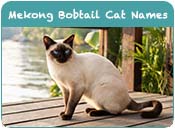
Every Mekong wears the colorpoint pattern: a pale body with darker “points” at the face, ears, legs and tail, in seal, chocolate, blue, lilac and related point colors, set off by clear blue eyes. This is the visual inheritance from the same gene pool that produced the Siamese, and it gives the breed an unmistakably regal, contrast-rich look. When you choose a name, the points and the eyes are the most paintable features you have to work with.
Temperament, the “dog-like” gait & male co-parenting
Mekongs are widely described as dog-like: sociable, people-oriented, intelligent, trainable and genuinely interactive rather than aloof. Two quirks stand out. First, the claws on the hind legs don’t fully retract into the pads, so on a hard floor the cat makes an audible click as it moves — owners describe it as walking “on its toes” or in tiny heels. Second, males are reported to take an unusually active role in raising kittens within a matriarchal family structure, helping teach and settle the litter. Both traits give you true-to-life naming angles few other breeds offer.
Names from the Mekong River & Southeast Asia
The river itself is the breed’s namesake, threading six countries. These geography-and-water names root your cat in its homeland.
- River — the plainest, truest nod to the Mekong itself.
- Delta — for the vast Mekong Delta where the river meets the sea in Vietnam.
- Monsoon — the seasonal rains that swell the river each year.
- Rain — soft, regional, and fitting for a water-born lineage.
- Marlowe — a riverboat literary echo for a cat who patrols its territory.
- Bangkok — the Thai capital on the Chao Phraya, evoking the breed’s urban palace roots.
- Saigon — the southern delta city, exotic and lively.
- Mekong — the breed’s own name worn proudly.
- Brook — a gentler water name for a small, quick cat.
- Bay — where the river finally empties out.
- Reed — the riverbank grasses of the floodplain.
- Tiger — for the wild cats of the Indochinese forests the river drains.
For place names that aren’t common dictionary names, write them plainly: Laos (the landlocked country the river runs through), Phnom (from Cambodia’s capital Phnom Penh), and Tonle (after the Tonle Sap, the great lake that reverses its flow with the river).
Thai & royal-Siamese heritage names
Because this cat is the old royal Siamese in everything but tail, Thai and palace-themed names fit it better than almost any other breed. Most genuine Thai words sit outside an English name dictionary, so they’re given here as plain glossed words; the broader regal names are linkable.
- Royal — the simplest claim on the breed’s palace heritage.
- Raja — “king” across South and Southeast Asia, for a regal male.
- Rani — “queen,” the matriarch the breed’s family structure already favors.
- Duchess — an aristocratic title for a poised female.
- Prince — a small heir to a long line.
- Siam — Thailand’s historic name, and the breed’s ancestral ground.
- Crown — for the temple-guardian, palace-cat lineage.
- King — direct and fitting for a co-parenting tom.
Authentic Thai words to use as plain glossed names: Mali (Thai for jasmine), Sangha (the Buddhist monastic community), Mekhala (a goddess of the waters in Thai mythology), and Chakri (the name of Thailand’s royal dynasty).
Colorpoint & blue-eye names
The pale body, dark points and blue eyes are the Mekong’s signature. These names paint the coat and the gaze directly — lean toward the point colors recognized in the standard.
- Sapphire — the clearest match for those deep blue eyes.
- Sky — bright, open blue for a pale-bodied cat.
- Indigo — a richer, twilight blue.
- Azure — the precise word for clear blue.
- Seal — for the dark seal-point face and ears, the classic point color.
- Cocoa — a soft pick for a chocolate-point cat.
- Lilac — the palest frost-grey point color, and a flower besides.
- Slate — a cool grey for a blue-point coat.
- Ivory — the pale, creamy body the points sit against.
- Cream — the warm body tone of many pointed cats.
- Sterling — silvery contrast for a frosted coat.
- Cobalt — the most saturated blue for the eyes.
- Hazel — a wry pick for a cat whose eyes stay resolutely blue.
Names that honor the kinked, short tail
The fingerprint tail is the breed’s defining feature, and it deserves a name of its own. Be honest and playful — these celebrate the kink rather than oversell it.
- Comet — a head with a short bright tail; the most poetic nod of all.
- Stubby — affectionate and literal for the short tail.
- Nubbin — a tiny, tender pick for the little tail.
- Pixel — small, distinct, one-of-a-kind, like the tail’s pattern.
- Twist — for the curve and kink no two cats share.
- Curl — the gentle bend of the tail.
- Bobbin — a soft play on “bob,” small and round.
- Dash — short, quick punctuation, like a clipped tail.
- Sprout — for the little tail that grows just so far.
- Maple — for a cat whose tail curls like a falling seed.
Plain glossed picks in this theme: Kink (the defining curve, used fondly) and Whisk (the brisk little flick the short tail makes).
Temple, Buddhist & lotus serenity names
The breed’s ancestors guarded temples, and the Mekong region is steeped in Buddhist culture and the imagery of the lotus that rises unstained from the water. These names carry that calm.
- Lotus — the sacred flower of the region, rising from river mud.
- Zen — quiet, centered, meditative.
- Buddha — for a serene, watchful temple-guardian cat.
- Lily — the water lily of the floodplain ponds.
- Jasmine — the fragrant flower (Mali in Thai) tied to offerings.
- Peace — the temple calm distilled to a word.
- Serenity — for a composed, unflappable cat.
- Sage — wise and herbal at once.
- Karma — a gentle Buddhist nod with a feline wink.
- Willow — the riverbank tree, supple and calm.
Jewel & treasure names
These were palace cats, and a jewel name suits a cat that came up through royal courts. The blue-eyed contrast practically demands gemstones.
- Jade — the prized green stone revered across Asia.
- Ruby — warm red brilliance for a bold cat.
- Pearl — pale, lustrous, like a colorpoint body.
- Opal — shifting color, like a tail no two cats share.
- Topaz — golden and bright.
- Amber — warm honey tones for a seal-point cat.
- Onyx — deep dark for the points.
- Crystal — clear and shining, like the eyes.
- Diamond — the treasure of a royal line.
- Garnet — a deep red jewel for a regal female.
- Emerald — green fire, a royal counterpoint to blue eyes.
- Coral — a softer treasure from the river’s mouth and the nearby sea.
Pairing names for two Mekongs
If you are bringing home two — and given how social and family-minded this breed is, two is a kind idea — let the names speak to each other. Lean on the river, the heritage and the matriarchal household.
- River & Delta — the Mekong’s whole journey, source to sea.
- Raja & Rani — king and queen, honoring the breed’s royal roots and its female-led family.
- Sapphire & Jade — blue eyes and green stone, two treasures.
- Lotus & Willow — two serene, water-loving plants of the floodplain.
- Seal & Lilac — the darkest and the palest point colors, a matched contrast.
- Comet & Pixel — two takes on the unique short tail.
- Siam & Mekong — the old homeland and the river it’s now named for.
Settling on the Right Name
The right name for a Mekong Bobtail usually lands in one of two places. Either you honor what the cat is — the last living version of the royal Siamese, river-born, temple-guarded, blue-eyed — with a heritage, river or temple name; or you celebrate the one feature that makes it utterly unique, that kinked little tail no other cat on earth shares, with a name like Comet or Twist. Both are true to the breed. Whichever way you go, you are naming a piece of living history that the rest of the cat world quietly bred away — and that the Mekong River kept.